7 Riding Position Faults That Show Up First in Cold Weather
Quick Answer: Cold reduces hip and ankle mobility and increases baseline muscle tension, which magnifies existing position faults rather than causing new ones. The seven below appear in roughly this order as temperature drops, and each has a specific warm-up fix.
Your position was fine in August. It is October and your instructor is repeating things you thought you had solved two years ago.
You have not regressed. Cold weather removes the mobility that was quietly compensating for faults that were always there.
Here are the seven, in the order they typically appear.
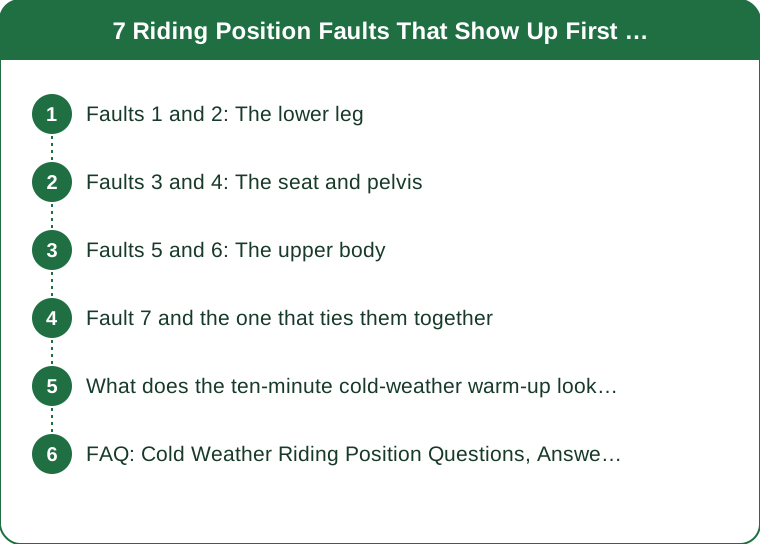
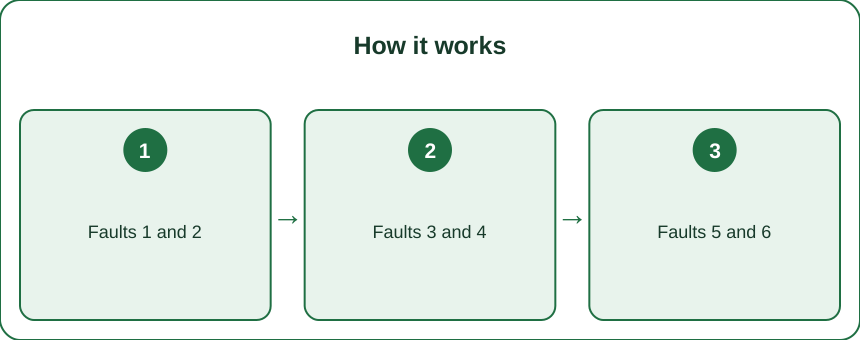
Faults 1 and 2: The lower leg
1. The creeping-forward lower leg
Cold ankles have less dorsiflexion, and an ankle that cannot flex sends the lower leg forward to find a position it can hold. This is the first fault to appear and the most commonly misdiagnosed one, because it looks like a balance problem and is actually a mobility problem.
The fix is ankle-specific and takes two minutes: 20 slow calf raises and 20 controlled ankle circles each direction before mounting, done in your boots.
2. The gripping knee
Cold adductors tighten, and a tight adductor grips. A gripping knee acts as a pivot point that lifts your seat away from the saddle, which then makes everything above it unstable.
Check for it by consciously releasing your knee at the walk and noticing whether your seat drops. If it does, you have been gripping. Five minutes of walk work with deliberately loose knees at the start of every cold session resets it before it becomes the ride.
Faults 3 and 4: The seat and pelvis
3. The chair seat
When hip flexors are cold and short, the pelvis rotates back and you end up sitting behind the movement with your legs in front of you. This is the fault most riders recognize and the one most often addressed at the wrong end — instructors say sit up, and the rider arches their back instead of freeing their hips.
The actual fix is hip flexor length before you mount. A 30-second kneeling hip flexor stretch per side, done properly with the pelvis tucked, changes more than ten minutes of being told to sit up.
4. The uneven seat bone
Everyone is slightly asymmetric, and cold amplifies it. The tighter side stiffens more, which means the seat bone on that side carries less weight and your whole position drifts.
Diagnose it at the halt: close your eyes and notice which seat bone you can feel more clearly. The one you cannot feel is the tight side. Add an extra 20 seconds of stretching to that side rather than trying to correct it in the saddle.
Faults 5 and 6: The upper body
5. The rising shoulders
Cold produces an involuntary shoulder lift — a protective posture that has nothing to do with riding and everything to do with temperature. Raised shoulders shorten the arm, which shortens the rein, which the horse feels immediately.
The fix is not a cue to relax, because you cannot relax cold muscles by deciding to. It is warmth: a layer over the shoulders specifically, and 20 shoulder rolls before mounting.
6. The stiff elbow
An elbow that stops following is the direct consequence of a raised shoulder, and it is the fault your horse notices before you do. A horse that starts head-tossing in cold weather is very often responding to a rein that has stopped breathing rather than to the weather.
Check it by riding at the walk with an exaggeratedly following arm for a full circuit. If the horse’s head and neck immediately relax, the elbow was the problem.
Fault 7 and the one that ties them together
7. The forward head
Looking down is a cold-weather habit as much as a riding one — you are watching the footing because the ground is wet, frosted, or covered. A forward head shifts your center of mass ahead of your seat and undoes the work everything below it is doing.
The fix is a deliberate focal point. Pick something at eye level at the far end of the arena and use it at the start of every cold session. Riders who struggle with this often do better with an auditory cue than a visual one — asking a friend to say up once per lap works better than trying to remember, because the habit you are fighting is unconscious.
It is also worth knowing that this fault feeds fault six directly. A forward head pulls the shoulders round, which raises them, which stiffens the elbow. Fix the head and two others improve without being addressed.
The thread connecting all seven is that none of them are riding faults in origin. Every one is a mobility or temperature response that riding then displays. This is why the productive intervention is a ten-minute pre-mount routine rather than a longer lesson, and why riders who add that routine often find their instructor stops mentioning things they have been mentioning for years.
What does the ten-minute cold-weather warm-up look like?
Done in your riding clothes, before you get on, in this order.
Ankles: 20 calf raises, 20 circles each direction. Two minutes.
Hips: kneeling hip flexor stretch, 30 seconds each side, pelvis tucked. Then 10 leg swings forward and back per side and 10 across the body. Three minutes.
Adductors: a slow side lunge, 10 per side, going only as deep as feels easy. Two minutes.
Shoulders and upper back: 20 shoulder rolls, 10 arm circles each direction, and a doorway or wall chest stretch for 30 seconds. Two minutes.
Spine: 10 slow rotations seated or standing, hands crossed on chest. One minute.
Then walk your horse for a full five minutes on a long rein before asking for anything. His mobility is affected by the cold in exactly the same way yours is, and the first five minutes of a cold session is not schooling time for either of you.
FAQ: Cold Weather Riding Position Questions, Answered
Should I ride shorter in cold weather?
One hole shorter for the first ten minutes can help if your ankles are stiff, but returning to normal length once warm is better than riding a whole session short. A permanently shortened stirrup changes your whole position to solve a temporary problem.
Why does my horse feel stiffer than usual too?
Because he is, for the same reasons. Equine muscle and connective tissue are equally affected by cold, and a longer walking warm-up benefits both of you. Fifteen minutes is not excessive on a genuinely cold day.
Is it worth riding indoors instead?
If available, yes, for quality work. An indoor arena removes both the cold and the footing uncertainty, which are the two factors driving most of these faults.
This is general information, not medical advice. Persistent joint pain after riding warrants a professional assessment rather than more stretching.
TL;DR:
- Cold does not create position faults; it removes the mobility that was hiding them.
- They appear in order from the ground up: lower leg, knee, seat, pelvis, shoulders, elbow, head.
- Each has a mobility cause, so a ten-minute pre-mount routine fixes more than in-saddle correction does.
- Walk your horse five to fifteen minutes on a long rein before asking for work, for the same reasons.
The position you had in August is still in there. It is being held hostage by an ankle that will not flex and a hip flexor that has been cold since you got out of the car — and ten minutes on the ground gets it back.
Keep Reading
This article is for general informational and styling purposes only. Fit, sizing, and product availability may vary.