7 Riding Position Faults That Actually Start in the Ankle
Quick Answer: The ankle is the base of the rider’s stability chain, and a locked, collapsed or rotated ankle propagates upward — producing a gripping knee, a swinging lower leg, a tipped upper body and unstable hands. Seven common position faults trace back to it. The core fix is a soft, weight-bearing ankle with the heel lower than the toe and weight distributed across the whole foot, not jammed down. This is general information, not veterinary or medical advice.
Most riding corrections happen from the top down. Shoulders back. Hands still. Sit up. Leg back.
You make the correction, hold it for four strides, and it comes undone — because the thing that was undoing it was never at the top.
The rider’s position is a stacked chain resting on the stirrup, and when the base of that chain is not doing its job, everything above it compensates. Here are seven faults that start there.

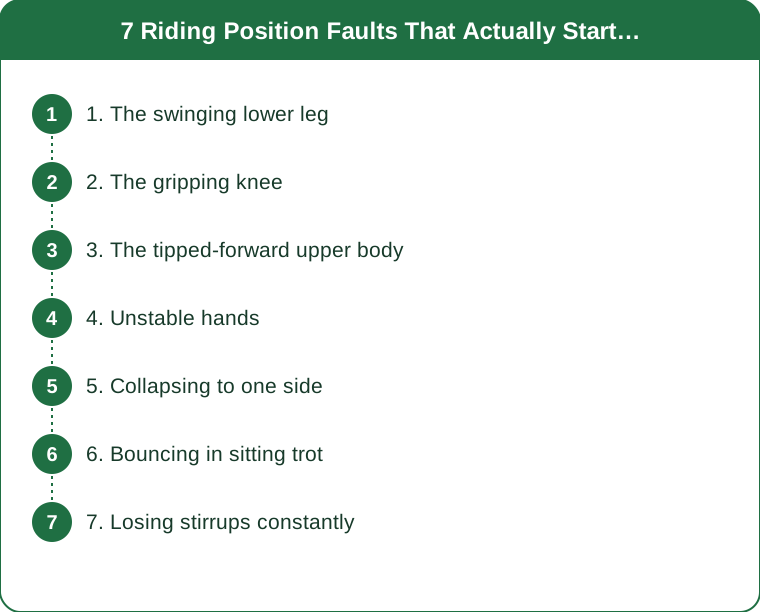
1. The swinging lower leg
The most visible fault and the most commonly misdiagnosed.
The correction usually given is to hold the leg still, which treats a symptom. A lower leg swings because it is not anchored, and it is not anchored because the ankle is not absorbing movement.
A stiff, locked ankle transmits the horse’s motion straight up the leg, and the leg responds by swinging. A soft ankle absorbs that motion at the joint, and the leg stays where you put it.
The fix: think of weight dropping through a soft ankle into the stirrup rather than pushing the heel down. Pushing the heel down forcibly locks the joint and makes the swing worse — which is why the standard correction so often fails.
2. The gripping knee
A knee grips when the ankle stops carrying weight.
The rider’s weight has to be supported somewhere. If it is not passing through the stirrup into a soft ankle, the knee takes over as a clamp — and a gripping knee acts as a pivot, which lets the lower leg swing and pushes the seat up out of the saddle.
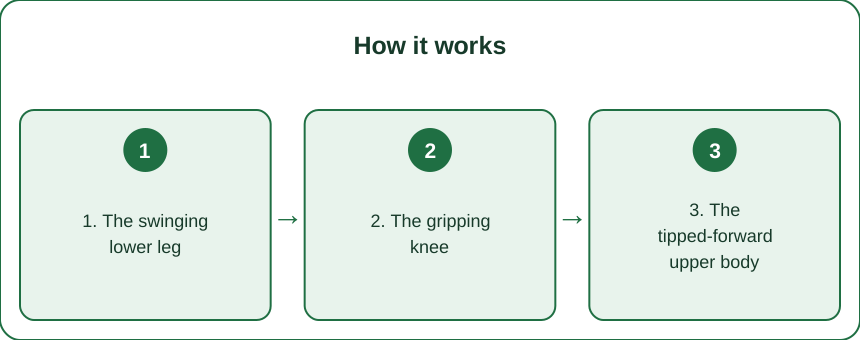
This produces the classic chain reaction: grip at the knee, swing below it, and a seat that bounces above it.
The fix: deliberately soften the knee and let more weight fall into the stirrup. It feels less secure at first, which is exactly why riders default to gripping. Security in riding comes from weight distribution, not from clamping — and this is one of the harder ideas in early riding to genuinely believe.
3. The tipped-forward upper body
Usually a balance response to a leg that has slipped forward.
If the foot is ahead of the hip, the rider is behind the vertical and must tip forward to rebalance. Instructors correct the shoulders; the shoulders are the compensation, not the cause.
The chair seat is the recognisable version — leg forward, seat back, torso tipped, and no ability to follow the horse’s movement.
The fix: re-establish the ear-shoulder-hip-heel vertical line, starting from the foot. Bring the lower leg back under the hip and the upper body corrects itself with no conscious effort.
A useful check: glance down and you should just be able to see the tip of your toe past your knee. If you can see your whole foot, your leg is too far forward.

4. Unstable hands
Hands move because the body underneath them is moving.
Riders are told to keep their hands still, and they try to do it by tensing the arms — which produces rigid arms rather than steady hands, and transmits every bump straight to the horse’s mouth.
Steady hands are a by-product of a stable base. If the seat and leg absorb the motion, the shoulders stay quiet and the hands follow naturally.
A locked ankle sends motion up through a straight leg into the torso, and the arms move with it. Riders then hold the reins tighter to compensate, which the horse feels immediately.
The fix: work on the ankle and seat, and let the hands alone for a while. Carrying a whip across both thumbs is a useful diagnostic — if it tips and rocks, the instability is coming from below, not from your hands.
5. Collapsing to one side
Often traced to uneven stirrup weighting rather than to a crooked spine.
Almost every rider is asymmetric, and the most common expression is more weight through one stirrup than the other. The hip on the weighted side drops, the opposite shoulder lifts, and the rider collapses through the ribcage.
Correcting the shoulders makes it worse by adding a second compensation on top of the first.
The fix: check stirrup length first — uneven leathers are extremely common and stretch at different rates. Then deliberately even the weight in both stirrups and let the torso settle.
Worth knowing: a rider’s asymmetry and a horse’s asymmetry reinforce each other over time. If one-sidedness persists after equipment checks, it is worth having both assessed rather than continuing to correct it in the saddle.
6. Bouncing in sitting trot
Bounce is unabsorbed motion, and it should be absorbed in three joints.
Ankle, knee and hip should each take a share of the movement. If the ankle is locked, the other two are asked to do the whole job, and they cannot — so the excess appears as bounce.
The instinctive response is to tense and grip, which reduces absorption further and makes it worse. This is the single most common frustration loop in learning to ride.
The fix: soften the ankle first, then allow the hip to open and close. Riders who fix sitting trot usually describe it as letting go rather than as trying harder.
A practical route in: short intervals. Ten strides of sitting trot with deliberate softness, then rise. Fatigue produces tension, and tension is precisely what you are trying to remove — so long sets are counterproductive early on.
7. Losing stirrups constantly
Usually a weight problem, not a foot problem.
If weight is not falling into the stirrup, the stirrup has nothing holding it against the foot and it slides off at the first moment of unbalance.
Riders respond by curling the toes up to hold on, which locks the ankle — and creates or worsens every fault on this list.
The fix: check the stirrup length first, since too long is the most common cause. Then focus on letting weight fall through the ball of the foot with a soft ankle. The stirrup should feel like it is being pressed into by your weight, not gripped by your foot.
Ride without stirrups occasionally. Short periods of stirrupless work at walk builds the deep seat that makes stirrup weighting natural, and it is the fastest route to fixing this and several other faults on this list. Build up gradually — it is demanding, and doing too much too soon produces soreness that interferes with the next few rides.
TL;DR:
- The ankle is the base of the rider’s stability chain — seven common faults propagate upward from it.
- A locked ankle causes the swinging leg, the gripping knee and the bouncing seat. Soft and weight-bearing is the goal, not a forced heel.
- Tipped-forward posture and unstable hands are compensations, so correcting the top rarely holds.
- Check equipment first for one-sidedness and lost stirrups — uneven leathers and over-long stirrups account for a surprising share of position problems.
- Short stirrupless intervals at walk build the weight distribution that makes all of this automatic.
The reason top-down corrections keep coming undone is that they are asking the body to hold a position its base cannot support. Spend a few sessions thinking about nothing above your knee, and it is common for two or three of these faults to quietly resolve on their own — which is a far better use of lesson time than holding your shoulders back for four strides at a time. This is general information rather than professional instruction; work with a qualified coach for anything specific to you and your horse.
Keep Reading
This article is for general informational and styling purposes only. Fit, sizing, and product availability may vary.