7 Reasons Your Riding Position Falls Apart the Moment You Get on a Different Horse
Quick Answer: Your position is partly a set of adaptations to one specific horse’s build, movement and saddle. Change the horse and the width of its barrel, the size of its stride, the shape of its back, the saddle and the horse’s own responsiveness all change at once - and your automatic adjustments no longer fit. Expect two or three rides of feeling wrong, and use them, because what breaks first tells you which part of your position was borrowed from the horse rather than built by you.
The canter transition you finally nailed in June is a mess on Tuesday’s horse.
Nothing about you got worse. The variables changed underneath you.

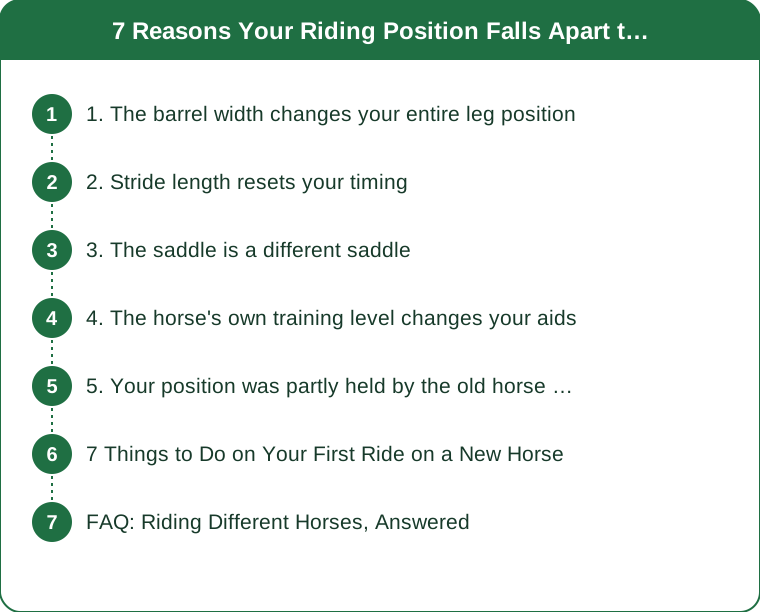
1. The barrel width changes your entire leg position
A wider horse pushes your thighs into more abduction, which changes where your knee sits, which changes where your lower leg can reach.
On a narrower horse your leg drops lower and closer, so the same aid applied with the same effort lands in a different place and produces a different response.
This is the single largest physical difference between horses for most riders, and it is almost never mentioned when people are told their leg has crept up.
Riders adapted to a wide horse frequently grip on a narrow one, because the leg suddenly has room to move and the reflex is to hold on.
Check your stirrup length first when switching. A hole shorter or longer often resolves what feels like a whole-position collapse.
And your hip mobility determines how much this affects you, which is one of the few parts you can actually train off the horse.
2. Stride length resets your timing
Posting trot timing is calibrated to a specific stride, and a bigger or smaller stride throws it off immediately.
A larger-moving horse throws you higher out of the saddle, requiring more core control and better timing to sit back down softly.
A shorter, quicker stride demands faster rise and fall and frequently leaves riders behind the movement for the first few minutes.
This is the most common cause of the ‘I have forgotten how to post’ feeling, which affects experienced riders too.
Give it five minutes on a circle before judging anything. Timing recalibrates faster than people expect once you stop fighting it.
And count out loud if you need to. It is unglamorous and it works.
3. The saddle is a different saddle
Seat size, twist width, flap length and stirrup bar position all differ, and each one moves where your pelvis sits.
A deeper seat holds you in one position; a flatter one lets you move and requires you to hold yourself.
A wider twist opens the hips more, which changes leg position exactly as barrel width does and compounds with it.
Stirrup bar position determines whether your leg naturally hangs under you or slightly forward, which is why some saddles seem to put you in a chair seat regardless of what you do.
Saddle fit is discussed almost entirely in terms of the horse, and it affects the rider substantially too.
Adjust stirrups before mounting and again after five minutes, since what looked right on the ground rarely is.

4. The horse’s own training level changes your aids
A well-schooled horse responds to a lighter aid, so riding one after a less responsive horse makes your aids look far too strong.
A greener horse needs clearer and more repeated aids, and riders coming off a schoolmaster often under-ask and conclude the horse is ignoring them.
The horse’s response speed changes your timing on transitions more than your technique does.
Riders frequently blame their own position for what is a communication calibration issue.
Ask what the horse is used to before you get on, which is a normal and useful question.
And expect the first ten minutes to be a conversation rather than a performance.
5. Your position was partly held by the old horse - and 6. the season changes both of you
5. The old horse was doing some of the work
A horse with smooth, balanced movement holds you in a good position in a way you stop noticing.
A horse that falls in on a circle or drifts through a shoulder demands corrections you had not been making, and those corrections are what feel like position collapse.
What breaks first is the most useful information of the ride. If your outside rein goes to nothing, that is what the previous horse was doing for you.
This is why riding multiple horses accelerates learning far more than the same horse for a year does, and it is why professionals ride many rather than perfecting on one.
Write down what broke, because it is the specific thing to work on next.
6. Cool weather changes both of you
Horses are typically fresher and more forward in cooler weather, particularly in the first cool weeks after summer, and a fresher horse magnifies any position instability.
Your own body is less warm and less mobile, especially riding in the early morning or evening as the season turns.
Warm up longer than you would in August - both the horse and yourself. More clothing changes your feel through the saddle, and thicker gloves change rein feel measurably.
The arena surface changes with moisture, which changes the horse’s movement and therefore what you are sitting on.
Expect the first few cool-weather rides to feel unfamiliar even on your regular horse, and considerably more so on a new one.
7 Things to Do on Your First Ride on a New Horse
Ask about the horse before you mount. What aids does it know, how forward is it, what does it do when it is unsure, and is there anything it dislikes. Two minutes of conversation prevents most of the first-ride confusion.
Check and adjust your stirrups on the ground, then again after five minutes of walking. Stirrup length is the single fastest fix for a position that feels wrong, and what looked right beside the mounting block frequently is not.
Walk for longer than feels necessary. Ten minutes of walking on a loose rein tells you about the horse’s stride, its balance and its responsiveness before you have to react at speed.
Post the trot on a circle before doing anything on a straight line. Circles give you consistent feedback about balance and let your timing recalibrate with fewer variables.
Do not try to ride the horse you know. Applying the aids and timing that worked on your regular horse is the most reliable way to spend the session frustrated. Ride the horse under you.
Notice what breaks first and write it down afterwards. Whether it is your outside rein, your lower leg, your posting rhythm or your upper body - that is the part of your position that was borrowed rather than built, and it is your next month of work.
Give it three rides before judging anything. The first ride on any unfamiliar horse is largely calibration. Riders who conclude they have lost their position after one session are drawing a conclusion from the least informative ride available.
FAQ: Riding Different Horses, Answered
Why do I ride so much worse on a new horse?
Because your position includes adaptations to your usual horse’s build, movement and saddle. Changing all of those at once means those adaptations no longer fit. It is calibration, not regression.
How long before I feel normal on a new horse?
Usually two to three rides for basic comfort, longer for finer work. The first ride is mostly information gathering.
Should I change my stirrup length for a different horse?
Often yes. Barrel width and saddle design both change where your leg naturally hangs, and a hole either way frequently resolves what feels like a broken position.
Is riding many horses better than riding one?
For developing a genuinely independent position, yes. Riding one horse builds a position partly held up by that horse; riding several exposes what you are actually doing.
Why is my posting rhythm off?
Posting timing calibrates to a specific stride length. A different-moving horse throws it immediately, and it recalibrates within a few minutes on a circle.
Why does my horse feel different in autumn?
Horses are often fresher in cooler weather, arena surfaces change with moisture, and your own mobility is lower when cold. Warm up both of you for longer.
What should I work on after a difficult first ride?
Whatever broke first. That is the part of your position the previous horse was supporting, and it is the most specific and useful training target you will get.
TL;DR:
- Barrel width, stride length, saddle geometry and the horse’s training level all change at once.
- Your position includes adaptations to one horse - change the horse and they no longer fit.
- Stirrup length is the fastest fix for a position that suddenly feels wrong.
- Whatever breaks first is what the old horse was doing for you, and it is your next training target.
- Walk for ten minutes and post on a circle before doing anything else.
- Cooler weather makes horses fresher and riders stiffer - warm up both for longer.
Give it three rides before concluding anything. The first one is calibration.
Keep Reading
This article is for general informational and styling purposes only. Fit, sizing, and product availability may vary.