7 Reasons Your Lower Leg Swings and What Each One Is Telling You
Quick Answer: A swinging lower leg is almost never a leg problem. It is a stability problem somewhere above the leg — usually the seat, the hip angle, or the stirrup length — and the leg is simply the visible end of it. The seven common causes each produce a slightly different swing pattern, and identifying which one you have matters far more than being told to keep your heels down again.
Being told to still your leg without being told why it moves is the single most frustrating thing in early riding.
Here is the diagnostic version.

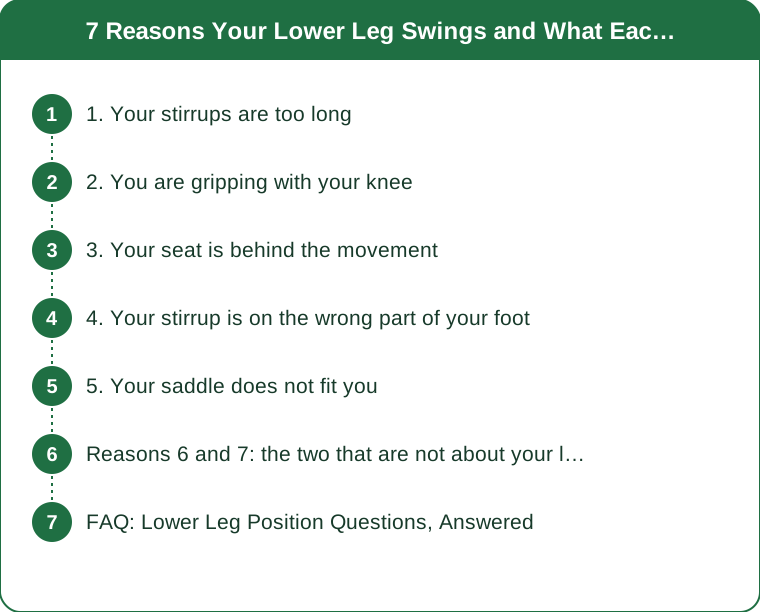
1. Your stirrups are too long
The most common cause and the easiest to check.
With stirrups too long, you have to reach for them with your toe, which straightens the knee and ankle and removes the shock absorption those joints normally provide. A straight leg has nothing to absorb the horse’s movement, so the movement passes straight through and the whole leg swings.
The telltale sign is a swing that is worst at the trot and that comes with a persistent feeling of reaching downward. You may also notice your toe pointing down without meaning to.
The check: at a halt, take your feet out of the stirrups and let your legs hang. The bottom of the stirrup iron should sit at roughly your ankle bone for flatwork. If it is below that, you are reaching.
The fix: shorten by one hole and ride for a full session before judging. It will feel cramped for about ten minutes and then feel correct.
This one accounts for a genuinely large share of swinging legs in riders who have been riding for under two years, and it is frequently mistaken for weakness.
2. You are gripping with your knee
A knee grip creates a pivot, and a pivot is what a swing needs.
When you grip with the knee, you fix that joint against the saddle and the lower leg becomes a pendulum hanging from it. Every stride swings it. The harder you grip to stop the swing, the more firmly you establish the pivot point, which is why gripping harder makes it worse.
The pattern here is distinctive: the swing is mostly back and forth rather than side to side, it worsens the more you try to control it, and you often finish rides with tired inner thighs and sore knees.
The check: at a walk, deliberately relax your knee and let your thigh drape. If the swing changes character immediately, gripping was the cause.
The fix: think about weight in the back of your thigh and in your seat rather than contact at the knee. Riding without stirrups at a walk for a few minutes each session teaches this faster than any cue, because you cannot grip with the knee and stay balanced without stirrups for long.
3. Your seat is behind the movement
If your seat is late, your leg is doing the correcting.
When your seat is not following the horse’s motion — usually sitting slightly behind it, with the pelvis tipped back — you are constantly a fraction of a beat late. The lower leg compensates by moving forward and back to keep you balanced, and that compensation is the swing.
The distinguishing feature is that the swing is worse in sitting trot and canter than in rising trot, and it comes with a feeling of being bumped rather than carried.
The check: ask someone to film you from the side. If your shoulder is behind your hip through the movement, the seat is the issue rather than the leg.
The fix: this one takes time and is best addressed on the lunge without reins, where you can focus entirely on following the motion. Trying to fix it by stilling the leg treats the symptom and usually makes the seat worse, because a fixed leg gives you something to brace against.

4. Your stirrup is on the wrong part of your foot
A small placement error with a large effect.
The stirrup should sit on the ball of the foot, angled slightly so the outside branch is ahead of the inside one. Too far back — towards the arch — and the ankle cannot flex properly, so the whole leg moves as one unit. Too far forward, on the toes, and the foot has no security and the leg searches for it.
The home-shoved stirrup is the more common error, particularly in riders who have been told to keep their heels down and are pushing the foot through to achieve it.
The sign is a swing that comes with a feeling of the foot being locked rather than springy, and often an ache across the top of the foot.
The check: look down at a halt. You should see the stirrup across the widest part of your foot, not against your boot heel.
The fix: reposition and expect it to feel insecure for a few rides. The security you lose is false security — a jammed-home stirrup is genuinely more dangerous in a fall.
5. Your saddle does not fit you
Not the horse — you.
A saddle with a seat too large for you lets your pelvis slide around, and a seat too small pushes you into a position you cannot hold. Either way, the stability that should come from sitting in the deepest part of the saddle is absent, and the leg compensates.
Stirrup bar position matters as much as seat size. A bar set too far forward puts your leg ahead of your body no matter what you do, which produces a characteristic forward-swinging leg that returns rather than a symmetrical swing.
This is particularly relevant for riders on lesson horses, where the saddle was fitted to the horse and to nobody in particular.
The check: sitting in the saddle, you should have roughly a hand’s width behind your seat and the deepest point should be where you naturally sit. If you are constantly sliding towards the cantle or perched at the front, the saddle is fighting you.
The fix: if it is a lesson horse, ask whether a different saddle is available — the answer is often yes. If it is your own, a professional saddle fitting addresses your position as well as the horse’s comfort.
Reasons 6 and 7: the two that are not about your leg at all
6. You are riding a different horse than usual
The swing may not be yours at all.
A horse with a bigger, bouncier stride produces more movement to absorb. A horse with a wide barrel changes your hip angle and makes it genuinely harder to keep the leg underneath you. A horse that is behind the leg requires more leg aids, which means more leg movement by definition.
Riders frequently conclude their position has deteriorated when they have simply moved to a horse that reveals things the previous one absorbed.
The sign is straightforward: the swing appeared when the horse changed, not gradually.
The check: ride your usual horse next lesson and see whether the swing is present.
The fix: mostly patience and slightly shorter stirrups on a wider or bouncier horse. It is entirely normal for a position to take several rides to adapt to a new horse, and it does not mean the position was fake.
7. Your core is not doing the job the leg has taken on
The cause people expect, listed last on purpose.
When the muscles that stabilise your trunk are not contributing, something else has to hold you in place, and the leg volunteers. This is real, and it is genuinely the cause for some riders — but it is diagnosed far more often than it applies, usually because it is the explanation that requires the instructor to say the least.
The distinguishing feature is a swing that is worse at the end of a lesson than at the start and worse in longer sessions, with a general sense of everything getting harder to hold together.
The check: is your first twenty minutes noticeably better than your last twenty? If the swing is constant throughout, fatigue is not the driver and one of the six causes above is more likely.
The fix: off-horse work aimed at trunk endurance rather than strength — planks and side planks held for time, dead bugs, and anything that trains you to hold a position while breathing normally. Twice a week is plenty. Expect eight to twelve weeks for it to show up in the saddle.
And do not let it be the default diagnosis. Six specific, fixable causes come before it.
This is general information, not veterinary or coaching advice specific to you and your horse. Persistent pain, or any concern about saddle fit for the horse, needs a professional assessment.
FAQ: Lower Leg Position Questions, Answered
How long does it take to fix a swinging leg?
If the cause is stirrup length or stirrup placement, immediately to a few rides. If it is knee gripping, a few weeks. If it is seat timing, a few months. This is why identifying the cause first saves so much time.
Should I ride without stirrups to fix it?
Work without stirrups is excellent for the knee-grip and seat causes and does very little for the saddle-fit or stirrup-length causes. Short sessions at walk, built up gradually, are more useful than long ones.
Why does my instructor keep saying heels down?
Because a dropped heel is the visible result of a leg that is working correctly. It is a description of the outcome rather than an instruction that can be followed directly — forcing the heel down while the underlying cause remains usually just jams the stirrup home.
Is a swinging leg dangerous?
Not in itself at the walk and trot. It becomes a genuine problem for the security of your position at the canter and over fences, and it makes your leg aids unclear to the horse, which is its own issue.
TL;DR:
- A swinging lower leg is a stability problem above the leg, not a leg problem
- Stirrups too long and stirrups jammed too far onto the foot are the two quickest fixes
- Knee gripping creates a pivot, so gripping harder makes the swing worse
- A seat behind the movement produces a swing that is worse in sitting trot than rising
- Core fatigue is real but massively over-diagnosed — check the other six causes first
Next lesson, film thirty seconds from the side before anything else. Which of the seven patterns you see decides whether this takes a ride to fix or a season.
Keep Reading
This article is for general informational and styling purposes only. Fit, sizing, and product availability may vary.