Rider Fitness Between Lessons: The Off-Horse Training That Shows Up in the Saddle
Quick Answer: Rider fitness is anti-movement core strength, mobile-but-strong hips, and leg endurance. Three short sessions a week — planks, dead bugs, and bird dogs for the seat; 90/90 rotations and deep lunges for the hips; wall sits and slow calf raises for two-point — will show up in the saddle within about four to six weeks.
Weekly lessons advance slowly when the body arrives unprepared. The horse can feel the difference between a rider who trained between lessons and one who parked, and it shows up in the first ten minutes.
The off-horse routine that fixes this is short and specific. Your instructor will notice, and will probably ask what changed.
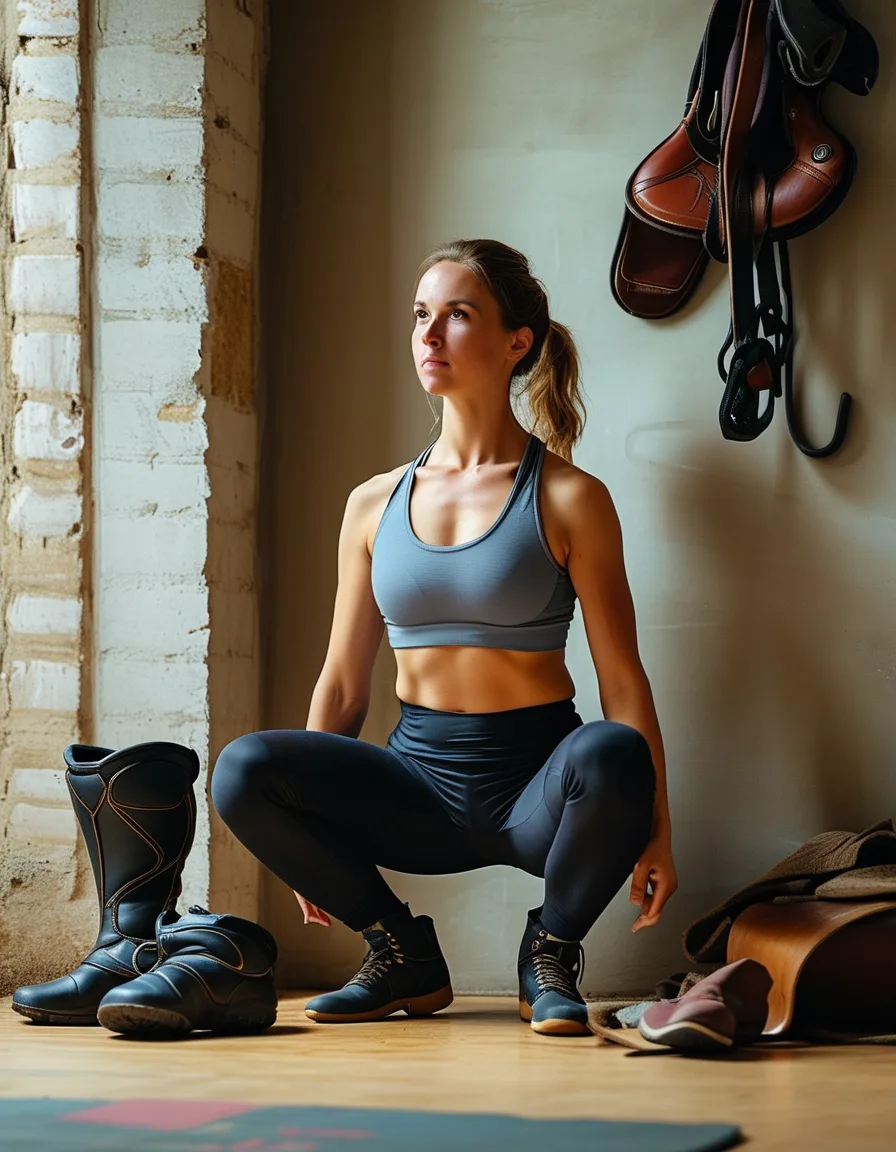

What Kind of Core Strength Does Riding Need?
Not sit-ups. Riding balance runs on anti-movement strength — the ability to hold a position while forces try to move you.
Planks and side planks. The seat’s stabilizers. Start at 30 seconds and build to 60.
Dead bugs. The single most riding-specific exercise there is. Lying on your back, opposite arm and leg extending while the torso stays completely still — that’s independent limb control, which is exactly what riding demands when your legs ask one thing and your hands ask another.
Slow bird dogs. Same principle, from a quadruped position, with the added balance challenge.
Ten minutes, three times a week. The seat improves measurably, and it’s the fastest-visible change of anything on this list.
Why Do the Hips Get So Much Attention?
Because riders need hips that open and control — mobility without floppiness.
90/90 rotations — seated with both knees bent at right angles, rotating side to side. Builds usable internal and external hip rotation.
Deep lunge holds — 45–60 seconds each side. This is the inner-thigh length the saddle demands, and most desk-bound bodies don’t have it.
Banded lateral work — side steps and clamshells with a resistance band. Your leg aids run on adductors and abductors, which most general gym programs skip entirely.
Supple hips absorb the horse’s motion. Stiff hips bounce against it, and the horse feels every bit of that.

How Do You Train for Two-Point?
The two-point position — standing in the stirrups — is a wall-sit with consequences. So train it directly.
Wall sits. Build toward 60 seconds. Start where you can hold good position and add 10 seconds a week.
Calf raises with slow negatives. Three seconds down on each rep. Heels-down position runs on calf length and strength, and the slow lowering builds both.
Step-ups. For mounting-block dignity, and for single-leg strength generally. Use a box or a sturdy stair, 3 × 8 per side.
Ankle mobility work. Kneeling ankle rocks against a wall. If your ankle can’t dorsiflex well, heels-down is a fight rather than a position.

What Does the Week Look Like?
Two 15-minute strength sessions — core block plus leg block, on non-consecutive days.
Daily hip minutes — five minutes of 90/90 and a lunge hold. This one is small enough that it actually happens.
A walking base — riders are athletes, and general endurance shows up directly in lesson stamina. Twenty to thirty minutes most days.
Sample week: Monday strength, Wednesday strength, hips daily, walks whenever. Lesson day is its own workout — don’t add strength training on top of it.
The horse does half the work in every lesson. The routine’s job is making sure your half arrives trained.
5 Mistakes Everyone Makes
- Training the wrong core. Crunches build flexion strength; riding needs anti-rotation and anti-extension. Dead bugs over sit-ups, every time.
- Stretching hips without strengthening them. Mobility you can’t control is instability. Pair every stretch with banded work.
- Ignoring ankles. Heels-down is limited by ankle mobility more often than by effort.
- Doing strength work the day before a lesson. Sore legs make for a stiff seat. Leave a day.
- Going long instead of frequent. Two 15-minute sessions beat one 45-minute session for this kind of adaptation.
FAQ
How long before this shows up in my riding?
Most riders notice a steadier seat in four to six weeks, and instructors often notice sooner. The hip mobility work tends to show first because it changes how you sit immediately.
Do I need a gym?
No. Everything here is bodyweight or a resistance band. A band costs about $10 and covers the entire lateral hip program.
Should I do this on lesson days?
Skip the strength work on lesson days — the lesson is the session. Keep the five minutes of hip mobility, ideally before you drive to the barn.
What if I only have ten minutes a week?
Dead bugs and a deep lunge hold. Independent limb control and inner-thigh length are the two things that transfer most directly to the saddle.
TL;DR:
- Riding core = anti-movement strength: planks, side planks, dead bugs, bird dogs
- Dead bugs are the most riding-specific exercise available
- Hips need mobility and control: 90/90s, deep lunge holds, banded lateral work
- Two-point is a wall sit — train wall sits, slow calf raises, step-ups
- Ankle mobility is what actually limits heels-down for most riders
- Two 15-minute sessions a week, daily hip minutes, a walking base
- Leave a day between strength work and lessons
- Expect visible change in four to six weeks
The lesson horse meets a slightly different rider every week. The routine decides whether that difference trends upward.
Keep Reading
This article is for general informational and styling purposes only. Fit, sizing, and product availability may vary.