7 Things Your Riding Instructor Notices Before You Even Sit Down
Quick Answer: Instructors read your groundwork, your posture walking, your tack handling, and your breathing long before you mount — and those signals predict the ride accurately. The seven things below are what experienced eyes are actually tracking, and most of them are fixable in a single session once you know they are being watched.
You thought the lesson started when you got in the saddle.
Your instructor thought it started when you walked past the tack room, and by then had already formed a fairly accurate prediction about how the first twenty minutes would go.
Here is what they were looking at.

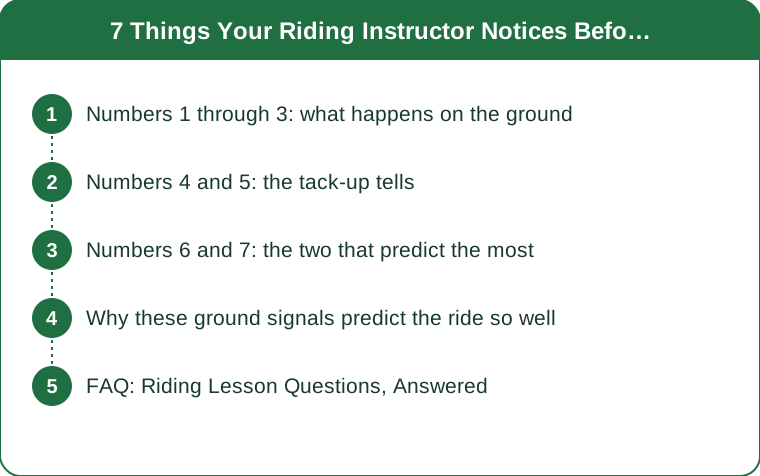
Numbers 1 through 3: what happens on the ground
1. Where you look when you walk toward the horse
Riders who look at the horse’s face approach differently than riders who look at the ground or their phone. Horses read approach direction and eye contact as intention. An instructor watching you cross the aisle is seeing whether the horse’s ears track you — and that tells them how the next hour will go before a word is spoken.
What to change: approach toward the shoulder, not the head, with your eyes up and your pace steady. Slow and direct beats fast and hesitant.
2. Whether you touch the horse before you do anything to the horse
Experienced riders make contact first — a hand on the shoulder or neck — before reaching for a headcollar, before picking up a foot, before anything. Newer riders reach straight for the equipment. Horses respond noticeably differently to each.
What to change: one deliberate hand on the shoulder, three seconds, every time. It is the smallest habit on this list and the one instructors notice fastest.
3. How you carry the tack
A saddle carried awkwardly against your hip tells an instructor about your core strength, your familiarity, and how tired your arms will be in forty minutes. A bridle carried in a tangle tells them you are about to spend three minutes untangling it while the horse waits and loses focus.
What to change: saddle on the forearm with the pommel at your elbow, bridle over the opposite shoulder with the reins looped. It looks like a small thing. It changes the first five minutes of every lesson.
Numbers 4 and 5: the tack-up tells
4. Your girth routine
Tightening the girth in one motion is the single most common beginner tell, and instructors watch for it specifically. It is uncomfortable for the horse and it produces the girthy behavior that then gets blamed on the horse’s temperament.
What to change: three stages with a walk between. Snug enough to hold at the mounting block, one hole tighter after a lap of walking, final check before you ask for trot. Most horses that are described as difficult about girthing are responding to a one-motion tighten.
5. Whether you check the same things every time
Instructors are looking for a sequence, not for expertise. A rider who checks the same five things in the same order every session — girth, stirrup length, bridle fit, noseband, reins untwisted — is a rider whose attention is available for the actual riding.
A rider who checks randomly is a rider who will discover a twisted rein at the canter.
What to change: build a fixed order and run it out loud under your breath for a few weeks until it is automatic. The point of a routine is not thoroughness, it is freeing attention.

Numbers 6 and 7: the two that predict the most
6. Your breathing at the mounting block
This is the one experienced instructors say predicts the ride most accurately. A rider holding their breath at the block will hold their breath at the first trot transition, and a held breath produces a locked lower back, which produces a bouncing seat, which produces a tense horse.
Horses are extraordinarily sensitive to breathing rhythm — it is one of the clearest signals they receive from a rider’s body.
What to change: two slow exhales before you put your foot in the stirrup, and one deliberate exhale at the moment you sit. Then keep breathing audibly for the first lap. It sounds absurd and it works within one session.
7. What you do with your reins while mounting
Riders who let the reins go slack while climbing on are telling the instructor they have not thought about what happens if the horse moves. Riders who grip too tight are telling them the opposite problem.
What to change: light even contact, slightly shorter on the inside rein, hand on the neck rather than the pommel. It costs nothing and it is the difference between a horse standing quietly and a horse taking two steps forward at exactly the wrong moment.
Why these ground signals predict the ride so well
Because riding is mostly a physical conversation, and every item on that list is part of the same conversation.
A held breath at the block is the same held breath at the canter transition. A rushed girth is the same rushed hand at the rein. An approach with your eyes down is the same downward gaze that collapses your posture in the saddle.
Instructors are not making mystical judgments. They are watching a set of patterns that stay consistent from the ground to the saddle, because they come from the same person under the same conditions.
The encouraging version of this: fixing the ground habits fixes some of the riding habits for free. Riders who deliberately slow their breathing during tacking up frequently report better trot work within two or three lessons, without having worked on the trot at all.
A note on safety: if any horse consistently behaves differently during handling — pinning ears at girthing, refusing to stand at the block, sudden changes in temperament — tell your instructor rather than adjusting your technique alone. Behavior changes can indicate pain, and saddle fit or dental issues need a professional. This is general information, not veterinary or medical advice.
FAQ: Riding Lesson Questions, Answered
Should I arrive early to tack up myself?
If your barn allows it, yes — 20-30 minutes earlier. The groundwork is where a large share of the relationship with a horse gets built, and riders who only arrive to mount a pre-tacked horse progress more slowly on the exact skills listed above. It also lets you meet the horse’s mood before you are sitting on it.
My instructor never mentions any of this. Should I ask?
Ask directly: what am I doing on the ground that I could improve? Most instructors prioritize in-saddle feedback during a paid lesson hour and will happily give you groundwork notes if invited. The question itself signals that you want the whole picture.
How long until these habits feel natural?
The tack-up sequence takes about three to four weeks of consistent lessons. The breathing habit is faster — most riders notice a difference within two sessions once they are consciously exhaling at the block. The approach and contact habits become automatic almost immediately because they are single actions rather than sequences.
TL;DR:
- Your lesson starts in the aisle, not the saddle — instructors read approach, contact, and tack handling as accurate predictors.
- Touch the horse before you touch the equipment, and approach toward the shoulder with your eyes up.
- Tighten the girth in three stages, not one, and run the same pre-ride check in the same order every time.
- Breathing at the mounting block is the single strongest predictor of how the ride goes.
- Keep light even contact while mounting, hand on the neck rather than the pommel.
What makes this list worth taking seriously is how cheap the fixes are. None of them requires more strength, better balance, or another year of lessons. They require about four minutes of attention spread across the tack-up, and they change the first twenty minutes of every ride you take from here on.
Keep Reading
This article is for general informational and styling purposes only. Fit, sizing, and product availability may vary.