7 Things That Change About Riding When the Weather Turns Cool
Quick Answer: Cooler weather changes riding in seven specific ways: horses are fresher and more reactive, your own muscles need a longer warm-up, footing behaves differently as ground moisture changes, tack becomes stiffer and less grippy, layering alters your position and feel, daylight shortens your usable window, and the horse’s coat and workload change how you cool them out. Each is manageable. Together, they explain why the first cool weeks of autumn produce more unplanned moments than any other time of year.
Here is what to expect and what to do about each.
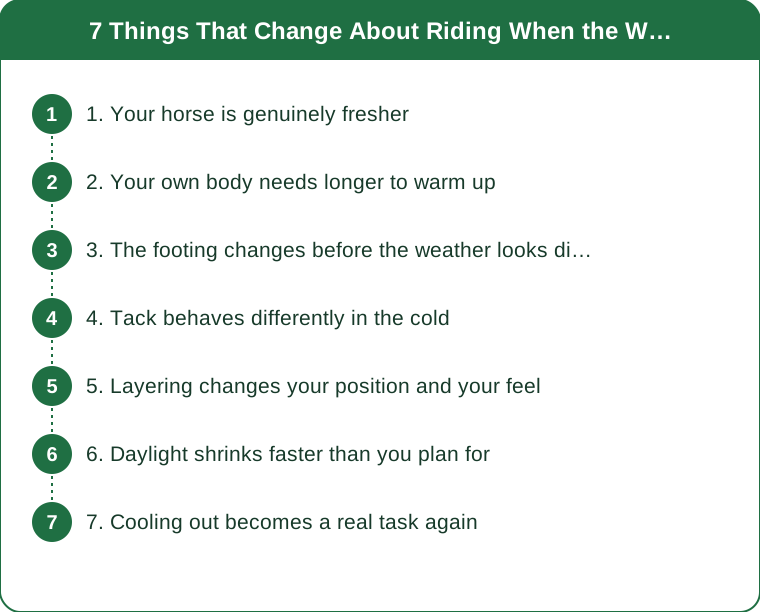
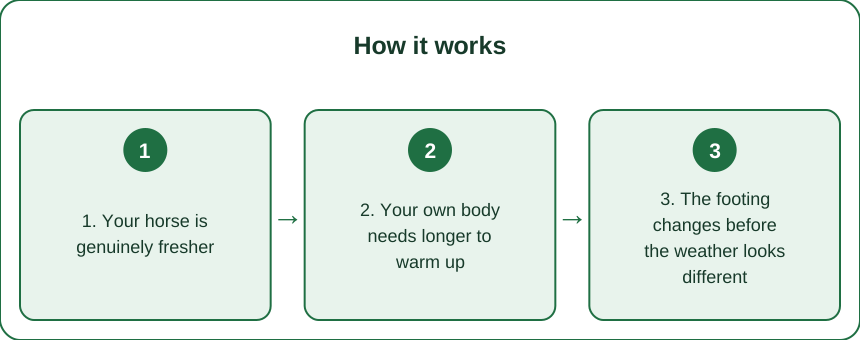
1. Your horse is genuinely fresher
This is the change riders notice first, usually while it is happening.
Horses are more comfortable in cool weather than in heat. Their thermoneutral zone sits well below what humans find pleasant, and a horse that was lethargic in August genuinely feels better in September. More comfortable means more energy available, and more energy tends to arrive as reactivity.
Several factors stack. Cooler air means less heat stress, so the horse is not conserving energy. Falling temperatures often coincide with reduced turnout as fields get wet, so there is less opportunity to expend energy before you get on. And wind, which increases in autumn, is genuinely stimulating for horses in a way that has nothing to do with temperature.
Practical response: extend the groundwork and the warm-up before you ask for anything. A longer walk phase, more transitions, more forward work before precision work. Riders who keep their summer warm-up routine into autumn are the ones getting surprised.
Also worth planning: turnout or lunging before a lesson during this window. Not as a punishment or a way to tire the horse out, but as an acknowledgment that a horse who has been standing in has energy to express before they can concentrate.
2. Your own body needs longer to warm up
Riders think about warming up the horse and rarely about warming up themselves.
Cold muscles are stiffer, and riding is a sport that demands hip mobility, an independent seat, and quick postural adjustments. Getting on cold means riding with less range and slower reactions for the first fifteen minutes — which is precisely the window when a fresh horse is most likely to do something unexpected.
The areas most affected are the hip flexors and adductors, which determine how deeply you can sit and how well you can keep your leg long and quiet. Cold hips ride short, and a short leg is a less secure leg.
Practical response: five minutes of movement before you mount. Walking briskly around the yard counts. Leg swings, a few squats, some trunk rotations. It is not a formal warm-up routine and it does not need to be — the goal is raising tissue temperature before you ask your hips to open into a saddle.
A related point about hands: cold hands grip harder. You will hold the reins with more tension than you intend, and your horse will feel it. Gloves that keep your hands genuinely warm are a rein-contact tool as much as a comfort item.
3. The footing changes before the weather looks different
Ground conditions shift earlier in autumn than most riders account for.
Outdoor arenas and fields hold more moisture as evaporation slows and dew persists later into the morning. Sand arenas that were dusty and loose in August become firmer and grippier, which changes how a horse pushes off and lands. Grass becomes slick, particularly on the first wet day after a dry spell, when water sits on hardened ground rather than soaking in.
This matters for the horse’s confidence as much as their safety. A horse who feels the ground behaving differently under them will shorten their stride, hesitate on turns, or feel unwilling in a way that reads as behavioral.
Practical response: walk the arena before you ride it, especially after rain. Reduce speed on turns for the first sessions on changed footing. Treat the first genuinely wet week as a transition period and keep the work simple.
The indoor equivalent: indoor arenas that were watered daily through summer may be over-watered as humidity rises, producing deeper going that tires horses faster than expected.
4. Tack behaves differently in the cold
Leather and cold do not get along, and the effects are practical rather than cosmetic.
Cold leather is stiffer and less grippy. Reins offer less feel and slide more readily through gloved hands. A stiff girth is less comfortable for the horse and less forgiving as they warm up and their ribcage expands. Stiff stirrup leathers hang differently.
Cold metal is its own problem. A cold bit is genuinely unpleasant for a horse to accept, and a horse who resists the bridle on a cold morning may simply be responding to temperature rather than developing a behavioral issue.
Practical response: keep the bridle inside where you can, or warm the bit in your hands before bridling. It takes thirty seconds. Condition leather more frequently as the season changes — cold and damp accelerate the drying and cracking cycle.
Check girth tightness twice. A girth done up on a cold horse with a tense ribcage will be looser once they warm up and relax, and this is one of the most common causes of saddle slip in autumn.
5. Layering changes your position and your feel
This is the one nobody warns new riders about.
Adding layers changes how you sit. A bulky jacket restricts shoulder movement and trunk rotation, both of which you use more than you realize for balance and for following the horse’s motion. A thick coat also physically separates you from the saddle at the seat and thigh, reducing the feedback you rely on.
Gloves change rein feel. Thicker gloves mean less sensitivity and, usually, more grip pressure to compensate.
And there is a subtle effect on your outline that instructors notice: layers make it harder to see your position, so feedback becomes less precise at exactly the point in the year when your position is degrading from the cold.
Practical response: favor fitted, technical layers over bulk. Several thin layers beat one thick one, both for warmth regulation and for preserving feel. A fitted vest or gilet keeps your core warm while leaving your arms free — for many riders this is the single best cold-weather garment.
Start the session with an extra layer you can remove after the warm-up rather than starting cold in what you will want later.
6. Daylight shrinks faster than you plan for
The rate of daylight loss in September and October is the fastest of the year, and it catches people out.
Losing several minutes a day compounds quickly. A ride that comfortably finished in daylight in late August is finishing in dusk three weeks later, and dusk is the worst light for riding — horses see differently in low light, shadows are long and confusing, and depth perception for both of you is reduced.
Horses are also genuinely more spooky at dusk. Their vision is adapted for detecting movement in low light, and their reaction to ambiguous shapes at that hour is not unreasonable from their point of view.
Practical response: work backward from actual sunset, not from when it starts feeling dark. Build in a buffer for untacking and turning out. Move sessions earlier as the weeks progress rather than compressing them.
If you ride at a yard with lights, expect that arena lighting creates its own shadows and that horses need a few sessions to be comfortable working under it. Do not introduce lighting and new work in the same session.
7. Cooling out becomes a real task again
In summer, a horse cools itself quickly in warm air. In autumn, a hot, damp horse in cool air is a genuine management issue.
A horse who has worked hard is wet with sweat and has a coat that is starting to thicken. Wet coat plus cool air plus wind removes heat rapidly, and a horse put away damp can get chilled — which is uncomfortable at best and a health concern at worst.
The coat itself is changing. Autumn coat growth means the coat holds more moisture and takes longer to dry, so the same amount of sweat produces a longer cooling-out period than it did a month ago.
Practical response: build cooling out into your session time rather than treating it as an afterthought. A cooler rug or an anti-sweat sheet after work, walking until breathing returns to normal, and checking that the coat is genuinely dry before turning out or putting away.
Consider whether your work should change. For many horses, this is the point in the year to shift toward work that produces less sweat — more technical, less sustained cardio — until clipping decisions are made.
This is general information, not veterinary advice. Any horse who does not recover normally after work, or who shows unusual behavior as the seasons change, should be assessed by a vet rather than managed as a training issue.
TL;DR:
- Cool weather makes horses genuinely fresher and more reactive; extend the warm-up rather than expecting summer behavior.
- Warm your own hips up before mounting, and keep your hands warm so your rein contact stays soft.
- Footing changes before the weather looks different — walk the arena after rain, and expect the first wet week to be slick.
- Warm the bit, condition leather more often, and check the girth twice as the horse warms and relaxes.
- Choose fitted layers over bulk, work backward from actual sunset, and build cooling out into your session time.
Pick the two of these that apply most to your setup and adjust for them this week. The first cool month is when small preparations prevent the moments nobody plans for.
Keep Reading
This article is for general informational and styling purposes only. Fit, sizing, and product availability may vary.