7 Things That Change About Riding Once the Weather Turns Cool
Quick Answer: Cool weather changes riding through the horse’s behavior, your own muscle readiness, and the footing. Horses are typically fresher and more reactive in cool air, your hips and lower back are stiffer before you warm up, and the arena surface holds moisture differently. Nearly every autumn riding complaint traces back to one of those three rather than to a technique problem.
You had a good summer. The first genuinely cool week arrives and suddenly your horse is looking at things, your position feels stiff, and a lesson that would have been routine in July is a fight. Nothing has gone backwards.
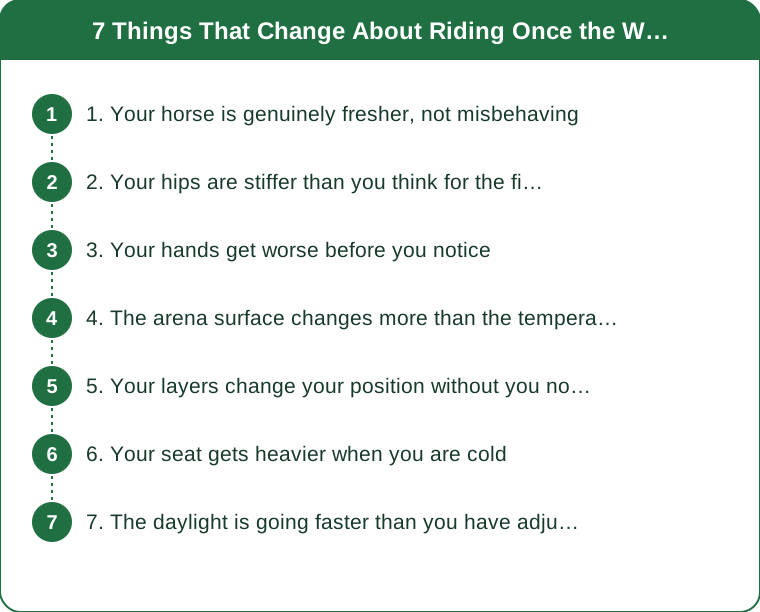
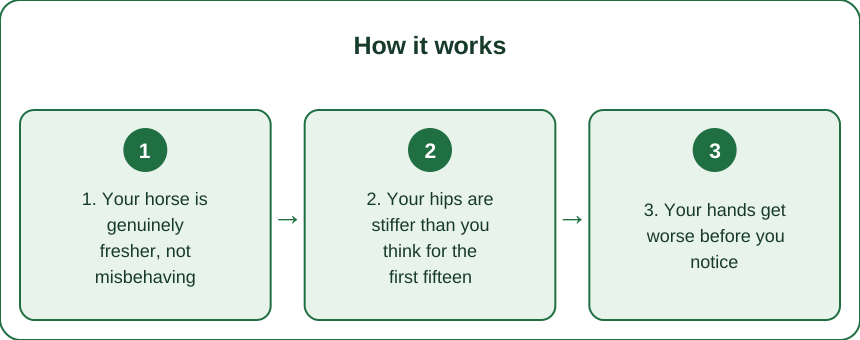
1. Your horse is genuinely fresher, not misbehaving
Cool air reduces thermal load, which means the same horse has more available energy for the same work. Add shorter turnout as daylight shrinks and a change in feed as the season turns, and the horse under you in October is a measurably different animal from the one in August.
Practically, this means the warm-up needs to be longer, not shorter. The instinct when a horse feels fresh is to get on with the work, which puts a high-energy horse straight into a task requiring concentration. Ten extra minutes of walking and long, low trot work costs you nothing and changes the entire session.
The reactivity is also real rather than imagined. Cool, breezy days carry sound and scent differently, and there is more moving in the environment — leaves, tarps, other horses reacting to the same conditions. A spook in October is usually an environment problem, not a training problem.
What to change: arrive earlier, walk longer, and set the bar for the session lower for the first week or two of a weather change.
2. Your hips are stiffer than you think for the first fifteen minutes
Riding position depends heavily on hip mobility, and cool muscles have less of it. That is not a fitness statement; it is a temperature one.
The visible consequence is a chair seat — hips not open, legs drifting forward, weight sliding toward the back of the saddle. You then correct with your lower back, which is where the next-day soreness comes from.
Warm up off the horse. Five minutes before mounting: leg swings, hip circles, a few deep lunges, some thoracic rotations. It sounds fussy and it changes the first twenty minutes of the ride substantially.
The other fix is not to judge your position in the first ten minutes. Cool-weather position at minute five is not your real position, and correcting hard against it just installs tension.
3. Your hands get worse before you notice
Cold hands lose fine motor control before they feel cold enough to be a problem. The result is rein contact that is less steady and less nuanced, and a horse that reads that instability as an inconsistent instruction.
This produces a specific pattern: the horse feels heavier in the hand and more resistant in cool weather, and the rider concludes the horse is being stubborn. Often the horse is responding to hands that have become blunt instruments.
Gloves are the answer, and specifically gloves thin enough to preserve feel. A too-thick glove trades one problem for another — you have warm hands with no sensitivity, which produces the same inconsistency by a different route.
The test: can you feel the difference between a soft and a firm contact through the glove? If not, it is too thick for riding regardless of how warm it is.
4. The arena surface changes more than the temperature does
Footing is the most underestimated autumn variable. As temperatures drop and moisture increases, an outdoor arena that was dry and loose all summer becomes packed and grippier — or, after rain, deeper and heavier.
Packed footing changes how a horse moves. More grip means more concussion and often a shorter, quicker stride. Deeper footing means more effort per stride and faster fatigue. Both change how a horse feels under you, and both are easy to misread as an attitude or soundness issue.
What to do: check the footing by hand before you ride, not just by eye. Press a heel into it. Adjust the session to the surface rather than expecting the surface to accommodate the session — deep footing is a day for shorter work at lower intensity, packed footing is a day to be conservative about tight turns and lateral work.
If a horse feels persistently off rather than just different, that is a conversation with a vet rather than a footing adjustment.
5. Your layers change your position without you noticing
A bulky jacket does two things: it restricts shoulder movement and it changes where your arms naturally hang. Both push your hands into a slightly different position, and rein length that was correct in a t-shirt is not correct in a winter coat.
The common result is hands carried slightly wider and higher, and a rider who feels like their contact has become unreliable without knowing why.
Layer thin and close rather than thick and loose. Multiple thin layers under a fitted vest preserve arm movement far better than a single puffy jacket, and a vest specifically leaves the shoulders free while keeping the core warm, which is the right trade for riding.
Check your rein length deliberately on the first cold ride of the season. It is almost always a hole or two different from what feels natural.
6. Your seat gets heavier when you are cold
Cold produces bracing — a low-level, unconscious muscular tension throughout the body. On a horse, bracing means a stiffer seat, less absorption through the lower back, and a rider who bounces slightly more at the sitting trot.
The horse feels this immediately, and typically responds by hollowing or by speeding up. This is one of the more common causes of the horse feeling tense in cool weather — it is receiving a tense seat.
The fix is breathing rather than position. Long exhales, particularly through transitions. It sounds like an odd intervention and it works because bracing and breath-holding are the same reflex.
Being warm enough is the more direct fix. A rider who is genuinely cold cannot ride softly, and no amount of position correction changes that.
7. The daylight is going faster than you have adjusted for
By late August the evenings are already noticeably shorter than they were in June, and the change accelerates through September. Riding in fading light changes how a horse sees the arena and how you judge distance.
Horses’ eyes adapt to changing light considerably more slowly than ours do. Moving from a bright yard into a dim indoor, or riding as dusk falls outdoors, means the horse is functionally seeing less than you are for a period of minutes. Spooking at the dark end of an arena in autumn is often exactly this.
Practical adjustments: allow adaptation time when moving between light conditions, do the technical work earlier in the session while the light is good, and finish with something low-stakes.
And the logistics point most people leave too late: if you ride after work, the calendar is about to remove your riding window. Working out now whether that means an earlier slot, a lighted arena, or a different weekday schedule is easier than doing it in the dark in October.
TL;DR:
- A fresher horse in cool air needs a longer warm-up, not a faster start
- Your hips, hands, and seat all lose function in the cold before you consciously feel cold
- Footing and light change how the horse moves and sees, and both are misread as behavior
- Layer thin and close, wear thin gloves, and re-check your rein length on the first cold ride
Autumn riding problems are seasonal, not skill-based. Adjust the warm-up, the layers, and the session expectations for a couple of weeks, and the ride you had in August comes back on its own.
Keep Reading
This article is for general informational and styling purposes only. Fit, sizing, and product availability may vary.