7 Signs Your Stirrup Length Is Wrong for the Work You're Doing
Quick Answer: Most riders find one stirrup length in their first months and never revisit it, then spend years fighting position problems that are actually length problems. Flatwork, jumping, and long trail work each want different lengths — and the classic wrist-to-armpit measurement is a starting point, not an answer.
Your instructor keeps telling you to lengthen your leg, sink your heels, and stop gripping with your knee. You’ve been working on it for months. Some of those cues are impossible to execute at the length you’re riding.

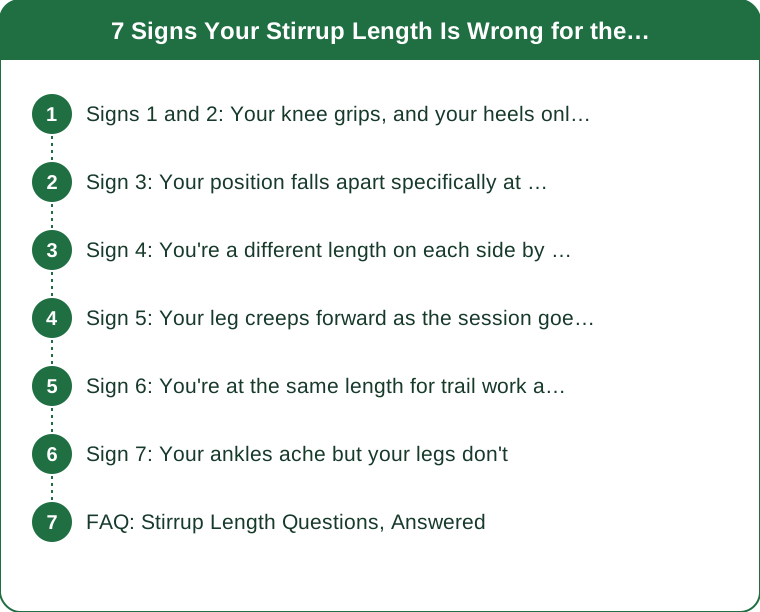
Signs 1 and 2: Your knee grips, and your heels only drop when you brace
Sign 1: The knee closes before you decide to
If you find your knee closing against the saddle without any conscious intent, the stirrup is probably too short for the work.
At a short length, the knee is closed more sharply and the natural resting position of the leg already involves knee contact. Being told not to grip with the knee, at a length where the knee is your only stable contact, is asking for something the geometry doesn’t allow.
Quick check: at halt, take your feet out of the stirrups and let your legs hang. Note where your knee sits. Put your feet back in. If your knee has moved noticeably forward and up, the stirrups are shorter than your neutral leg position wants — and every correction you’re being given about leg position is fighting that.
Sign 2: The heel only goes down when you brace
Sinking the heel should come from the weight of your leg dropping through a relaxed ankle. If it takes muscular effort — if you have to push against the stirrup to achieve it — the length is usually wrong in one of two directions.
Too long is the more common cause. Reaching for the stirrup means you’re extending the ankle to keep contact, which makes dropping the heel actively impossible. The tell is that your toe points down and your leg feels like it’s stretching.
Too short produces a braced heel instead — the heel goes down but through pushing rather than weight, and your calf tightens within twenty minutes.
The distinguishing question: does your heel stay down when you stop thinking about it? A correct length holds it there passively.
Sign 3: Your position falls apart specifically at the sitting trot
Sitting trot is the most position-revealing gait, and it’s where length errors surface first.
Too long, and you lose the ability to absorb movement through the ankle and knee, so absorption goes into your lower back instead — which is why sitting trot leaves some riders with back soreness and others with none at the same skill level.
Too short, and you get bounced upward because your leg has no room to act as a shock absorber. You’ll find yourself gripping to stay put, which stiffens everything and makes the bounce worse.
If your walk and rising trot look fine but sitting trot is a mess, look at length before you look at technique.
Sign 4: You’re a different length on each side by the end of a lesson
Extremely common and almost always ignored.
Most riders have a slight asymmetry — a longer leg, a stronger side, a hip that sits differently. Over a session, uneven weight through the stirrups causes the leathers to stretch at different rates, and one side becomes genuinely longer over weeks.
Check both leathers against each other on the ground every month or so. Also swap them left to right periodically; most saddle leathers are designed for this and it evens out the stretching.
If you consistently feel more secure on one side, uneven length is one of the more likely explanations — and it’s the cheapest one to rule out.

Sign 5: Your leg creeps forward as the session goes on
The chair seat — leg forward, seat behind the motion — is one of the most persistent position faults, and length is frequently the cause rather than the symptom.
When the stirrup is too long, the rider unconsciously pushes the foot forward to maintain contact, which slides the seat back. Being told to bring the leg back works for about four strides.
Test it: shorten by one hole and ride ten minutes. If the leg stays underneath you without conscious effort, you’d found a length problem rather than a habit problem. Most riders are surprised by how much of what they’ve been treating as a positional weakness disappears with a single hole.
Sign 6: You’re at the same length for trail work and flatwork
These are genuinely different jobs and they want different settings.
Flatwork wants a longer leg — more contact area, a deeper seat, more subtle aids available. This is where the classic dressage-length recommendations come from.
Jumping wants shorter, so you can close the hip angle and get out of the saddle without the leg swinging.
Long trail riding wants something in between, closer to the jumping end. Hours in the saddle at a flatwork length produces knee and hip fatigue that a slightly shorter setting largely prevents — and on hills, a shorter length gives you a much better ability to stay balanced over the horse’s movement.
The two-hole rule
A reasonable starting framework: whatever your flatwork length is, go two holes shorter for jumping and one hole shorter for a long trail ride. Adjust from there — but riding one length for everything is nearly always a compromise that serves nothing well.
Sign 7: Your ankles ache but your legs don’t
A specific pattern worth recognizing.
Ankle soreness without corresponding calf or thigh fatigue usually indicates the ankle is doing stabilization work the length isn’t allowing it to do passively. Frequently this is a slightly-too-long setting where the rider is holding the foot in position rather than resting it there.
The other possibility is stirrup iron width — an iron that’s too narrow forces the foot into a fixed position and transfers movement into the ankle joint. There should be roughly a thumb’s width of clearance on each side of the boot.
And the third: riding in boots with a different heel height than the ones you set your length in. A half-inch heel difference is effectively a hole of stirrup length, and it’s the most overlooked variable of the three.
When to get it looked at
Ankle pain persisting beyond a session, or any pain that changes how you walk, is worth having assessed rather than adjusted around. This is general information, not medical advice.
FAQ: Stirrup Length Questions, Answered
Is the wrist-to-armpit measurement reliable?
As a starting point, yes. As a final answer, no — it doesn’t account for saddle type, leg-to-torso proportion, or the work you’re doing.
How often should I reassess?
Any time you change saddles, change boots, or notice a position issue that isn’t responding to instruction. Otherwise a couple of times a year.
Should beginners ride shorter or longer?
Slightly shorter than the classical recommendation, usually. Security comes first, and a shorter length is more forgiving while balance is developing.
Does the horse notice?
Yes — leg position changes where your aids land and how your weight distributes. A length change often produces a noticeable response in the horse within one session.
My instructor set my length. Should I change it?
Talk to them first, and frame it as a question about the work rather than a disagreement. Most instructors adjust length by discipline and simply haven’t mentioned it yet.
TL;DR:
- Involuntary knee grip, braced heels, and a forward-creeping leg are usually length problems
- Sitting trot exposes length errors before any other gait
- Check leathers against each other monthly and swap sides — uneven stretch is common
- Flatwork, jumping, and trail work each want a different length, roughly two holes apart
- Boot heel height changes effective length as much as a full hole does
A lot of position coaching is trying to correct with effort what one hole of stirrup adjustment fixes structurally. Rule out the setting before you spend another season on the habit. This is general information, not medical advice.
Keep Reading
This article is for general informational and styling purposes only. Fit, sizing, and product availability may vary.