7 Riding Position Mistakes That Show Up in Your Lower Back the Next Day
Quick Answer: Most riding-related back pain comes from a position where your pelvis cannot absorb the horse’s movement, so your lumbar spine does it instead. The seven usual culprits are gripping with the knee, stirrups at the wrong length, a chair seat, bracing against the reins, collapsing on one side, holding your breath, and riding a horse whose movement exceeds your current core endurance. Each is a specific fix, and most of them show results within a single lesson.
Riding looks passive and is not, which is exactly why the consequences arrive the following morning.
This blog has covered how saddle fit affects the rider and not just the horse, the hip flexor tightness connection, and why your ankles ache after lessons. This is the lower back version, and it is the most common complaint of the three.
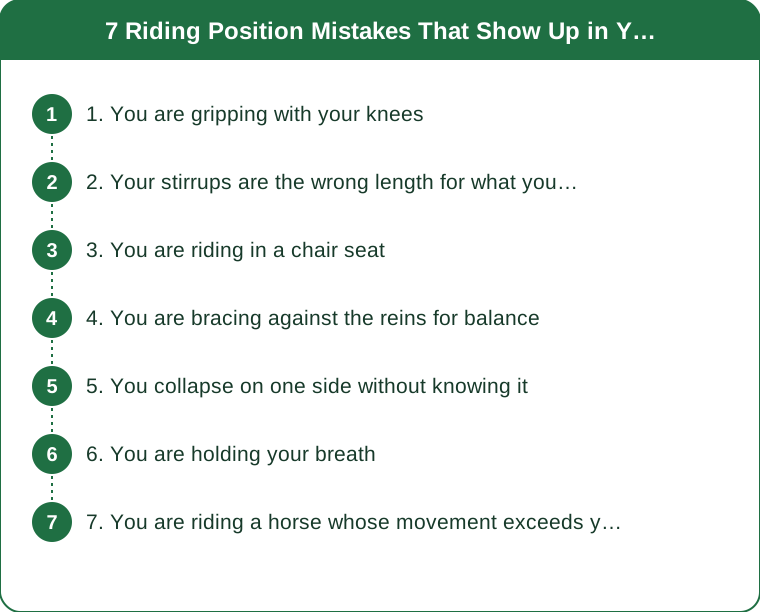
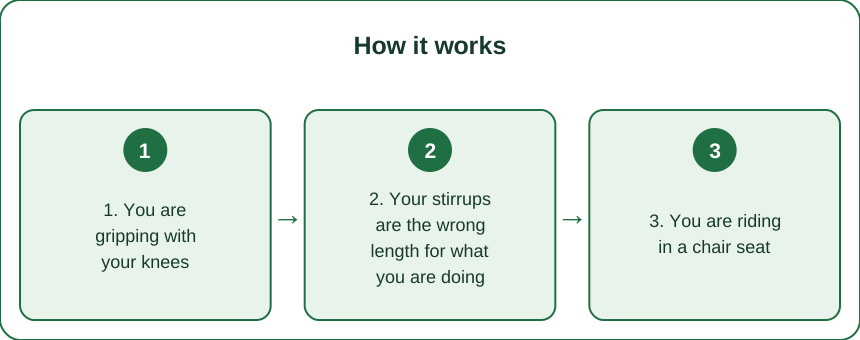
1. You are gripping with your knees
Knee grip locks your hip joint, and a locked hip cannot absorb movement. When the hip stops moving, the horse’s motion travels straight up into your lumbar spine, which then flexes and extends thousands of times per lesson.
The grip is almost always unconscious and it is almost always a security response. Feeling unstable produces gripping, gripping reduces your actual stability, and the loop reinforces itself.
The fix is a deliberate check at the walk. Every few minutes, consciously let both knees soften away from the saddle and notice whether your seat sinks slightly deeper. If it does, you were gripping.
Build the alternative rather than just removing the grip. Security comes from a following seat and from your leg hanging long with weight in your heel, not from clamping. Riding without stirrups at the walk for a few minutes each session builds this faster than anything else.
Expect it to feel less secure at first. It genuinely is less secure in the short term, and it becomes considerably more secure over a few weeks as your seat learns to follow rather than clamp.
2. Your stirrups are the wrong length for what you are doing
Too long forces you to reach for them, which tips your pelvis and drops your heel below a position you can control. You end up gripping upward to stay in contact.
Too short pushes your knee up and forward, closing your hip angle and pushing your seat back. This produces a chair seat, which is the subject of the next point and the biggest single contributor to lower back load.
Length depends on the discipline and it changes within a session. Flatwork and jumping are different lengths, and many riders never adjust between them because it interrupts the flow of a lesson.
The rough check: stirrup irons should hit around your ankle bone when your legs hang free. From there, expect a hole shorter for jumping and possibly a hole longer for dressage work.
Recheck after twenty minutes. Leathers stretch, especially newer ones, and an uneven stretch between left and right is extremely common. Riding thirty minutes with one stirrup a hole longer than the other produces exactly the one-sided lower back ache people report.
Look at the wear holes on your leathers. If one side is visibly more worn, you have been riding uneven for a long time, which is worth knowing.
3. You are riding in a chair seat
A chair seat means your feet are ahead of your hips and your pelvis is tipped backward. In this position your lumbar spine is flattened or rounded and it cannot absorb anything.
It is the most common position fault in adult riders and it comes largely from spending the rest of the day sitting, which shortens hip flexors and teaches the pelvis to sit in posterior tilt.
The check is the ear-shoulder-hip-heel line. From the side, those four points should stack roughly vertically. In a chair seat, the heel is clearly ahead of that line.
The fix is upstream of the saddle. Hip flexor length and glute activation determine whether you can even achieve a neutral pelvis on a horse. If you cannot sit upright with your legs underneath you on the ground, you will not manage it mounted.
On the horse, think about the back of your thigh rather than the front. Cueing riders to draw the leg back from the hip rather than pushing the heel down produces a better position more reliably.
And check the saddle itself. A saddle whose lowest point sits too far back physically forces a chair seat regardless of your ability, and no amount of trying harder overcomes it. This is the point where a saddle fitter is worth more than another lesson.
4. You are bracing against the reins for balance
Using the reins for balance creates a closed chain from the horse’s mouth to your lower back. Every time the horse’s head moves, the force travels through the rein, up your arm, through your shoulder, and into your lumbar spine, which resists it.
It also produces a horse that braces back, which increases the force, which increases your bracing.
The diagnostic is simple: can you drop both reins at a trot and stay balanced? If not, you are using them for balance to some degree, and that is worth knowing without judgement.
Neck strap or mane, not reins. If you need something to hold, use a neck strap. It gives you the security without transmitting anything into the horse’s mouth, and it lets you work on your seat honestly.
Work on the lunge if you can. Riding on the lunge without reins is the single most effective way to separate your balance from your hands, and it is the reason it remains a standard part of serious rider training everywhere.
Watch your elbows for the tell. Elbows that lock straight are elbows being used as struts. Elbows that stay softly bent and follow are elbows doing their actual job.
5. You collapse on one side without knowing it
Almost every rider is asymmetric, and the asymmetry shows up as a collapsed hip on one side. One seat bone carries more weight, one shoulder drops, and your lumbar spine side-bends to compensate for the whole session.
This produces the very specific complaint of one-sided lower back pain, usually on the same side every time.
Get it filmed from behind. You cannot feel this reliably, because your proprioception has normalised whatever your habitual position is. A phone on a fence post at C for two minutes tells you more than a season of trying to feel it.
Check your saddle for the evidence. Uneven wear on the seat, panels that have compressed differently, or a saddle that consistently slips to one side are all signs of a rider sitting crooked, and they are visible without any filming.
Address it off the horse too. Riding asymmetry usually reflects an existing asymmetry in hip mobility or trunk strength. Single-sided work in the gym, particularly single-leg and anti-rotation exercises, transfers well here.
And rule out the horse. Horses are asymmetric too, and a horse that consistently drifts one way will sit a rider crooked. If your position is worse on one rein specifically, that is a clue pointing at the horse rather than at you.
6. You are holding your breath
Breath-holding rigidifies your entire trunk. A held breath means a braced diaphragm and a pressurised abdomen, which is useful for a single heavy lift and counterproductive for forty minutes of absorbing movement.
It happens most at the moments requiring concentration, which is exactly when you most need to be able to follow the horse.
The tell is a rider who goes quiet in transitions. If you stop talking or stop breathing audibly when something difficult comes up, you are holding.
Fix it with an external cue. Counting strides out loud, humming, or exhaling deliberately on every downward transition all work. The specific cue matters less than having one, because internal reminders to breathe get forgotten within thirty seconds.
It also affects the horse. Horses are highly responsive to a rider’s breathing and tension, and a rider holding their breath transmits that immediately. Riders who fix their breathing frequently report the horse relaxing at the same time, which is not a coincidence.
7. You are riding a horse whose movement exceeds your current core endurance
A big-moving horse demands more absorption per stride than a small-moving one. If your trunk endurance runs out at twenty minutes and the lesson is fifty, you spend thirty minutes riding with a fatigued core, and your lumbar spine takes over.
This is not a criticism of anyone’s riding. It is an endurance mismatch and it has a training solution.
The signature is pain that appears only on longer sessions or only on one particular horse. If you are fine on a schoolmaster for an hour and sore after twenty minutes on a young warmblood, this is your answer.
Build trunk endurance specifically, not trunk strength. Long holds and time-based work transfer better here than heavy short sets. Side planks, dead bugs held for time, and loaded carries are the useful category.
Break long sessions with genuine walk breaks on a loose rein. Two minutes of real rest every fifteen minutes lets postural endurance recover and is better for the horse too.
And accept that this takes months, not weeks. Postural endurance builds slowly. In the meantime, shorter sessions on the demanding horse are better riding than long ones done badly.
One note worth stating plainly. Back pain that radiates into a leg, comes with numbness or weakness, or persists for more than a couple of weeks is not a position problem to ride through. See a physiotherapist or doctor. This is general information, not medical advice.
TL;DR:
- Most riding back pain is a pelvis that cannot absorb movement, so the lumbar spine does the absorbing instead.
- Check knee grip, stirrup length including left-right evenness, and whether you are in a chair seat. Those three cover most cases.
- Reins used for balance transmit force straight into your lower back, and a neck strap solves it immediately.
- One-sided pain usually means a collapsed hip. Film yourself from behind, because you cannot feel it.
If the pain only shows up on one particular horse, it is an endurance mismatch, and the fix is time-based trunk work plus shorter sessions for now.
Keep Reading
This article is for general informational and styling purposes only. Fit, sizing, and product availability may vary.