7 Riding Position Faults That Start in Your Seat Not Your Hands
Quick Answer: Most riding position faults are compensations for an unbalanced seat, not independent errors. If your pelvis is tipped or your weight is behind the movement, your body corrects at the extremities - hands, heels, shoulders - because those are the only places left to balance from. Correcting the extremity treats the symptom and leaves the cause, which is why the same correction gets repeated lesson after lesson. Fix the seat and several faults resolve at once.
Seven common faults, and where each actually begins.

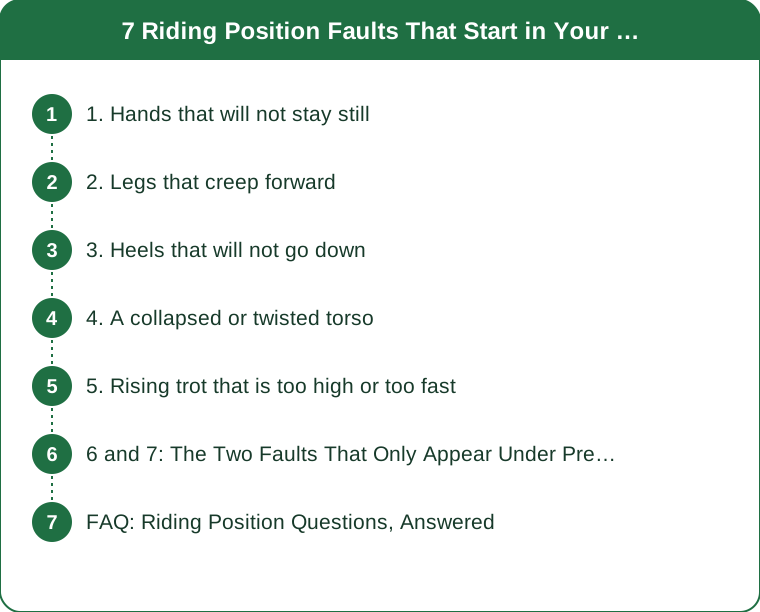
1. Hands that will not stay still
Busy, bouncing, or bracing hands are almost always a balance problem. If your seat is not independently balanced, your arms become part of the balancing system - and anything used for balance cannot also be used for communication.
Watch where it happens. Hands that are quiet at walk and busy at sitting trot tell you the seat cannot absorb that gait yet. The hands are reporting on the seat.
The classic version is holding the reins for support. Often subtle - a slight bracing rather than an obvious pull, but the horse feels it continuously, and it produces exactly the resistance the rider is then told to fix with softer hands.
The fix is not in the hands. Riding on the buckle or holding a neck strap in the transitions where hands get busy exposes the seat and forces it to do its own job. It feels considerably worse before it feels better.
And check the shoulder and elbow first. A locked elbow removes the shock absorption that should sit between an independent seat and a soft hand, so even a good seat produces hard hands if the arm is rigid.
2. Legs that creep forward
A leg that drifts ahead of the girth is the classic signature of a pelvis tipped backwards. Sit behind the vertical and the leg swings forward as a counterweight - it is a balance response, not a leg-position error.
Trying to hold the leg back against a tipped pelvis fails, because you are fighting the mechanics rather than fixing them. The leg goes back for a few strides and then returns.
Chair seat is the compounded version: pelvis behind the vertical, legs forward, and the rider’s weight behind the horse’s movement. The horse then has to carry a load that is constantly slightly late, which affects everything from transitions to straightness.
Stirrup length is frequently the cause. Too short forces the knee up and the pelvis back; too long produces reaching and a hunting for the stirrup that unsettles the whole position. Small changes here fix apparently unrelated faults.
And check the saddle before blaming yourself. A saddle whose balance point sits too far back puts every rider in a chair seat, regardless of ability, and no amount of correction overcomes it.
3. Heels that will not go down
Forcing the heel down produces a braced leg and a stiff seat, which is worse than a level foot. The heel is meant to be the visible result of weight dropping through a relaxed leg, not a position achieved by pushing.
If the heel comes up, the weight is not going down through the leg. Usually because the rider is gripping with the knee or thigh, which lifts the seat away from the saddle and blocks the weight from reaching the foot.
Grip is itself a balance response. Riders grip when they do not feel secure, so telling a gripping rider to relax rarely works - the grip goes when the balance arrives.
Ankle mobility is a genuine physical limit for some riders. Limited dorsiflexion means the heel cannot drop far regardless of technique, and that is worth addressing off the horse rather than fighting in every lesson.
And a heel forced down hard blocks the ankle’s shock absorption, which sends more movement up into the seat - producing exactly the instability that started the whole chain.

4. A collapsed or twisted torso
Sitting crooked is extremely common and almost never conscious. Most riders have a dominant side, sit slightly heavier on one seat bone, and have done so for years without knowing.
The horse adapts to it, which hides it further. A horse that consistently drifts one direction, or is stiffer on one rein, is frequently responding to an asymmetric load rather than expressing its own crookedness.
Off-horse asymmetry transfers directly. Habitual sitting, an old injury, or carrying a bag on one side all show up in the saddle, because the saddle is where small asymmetries become obvious.
Mirrors and video are the only reliable detection. Crookedness feels straight from inside - that is precisely why it persists. What feels straight to a crooked rider is crooked, and what feels crooked is straight.
Correcting it feels wrong for weeks. Straight will feel over-corrected until the proprioceptive map updates, which is a matter of weeks rather than sessions, and giving up in week two is what returns everyone to the original pattern.
5. Rising trot that is too high or too fast
Rising too high comes from pushing with the leg rather than being lifted by the horse. The horse’s movement should do most of the work; the rider’s job is to allow and control the return.
Too fast usually means the rider is ahead of the movement, which puts weight forward at the wrong moment and unbalances the horse - and then the rider is told to slow the horse, which is the wrong end of the problem.
The return is where the actual skill sits. Sitting down softly and with control requires core stability, and the noise of a heavy return is what most horses object to.
Check which diagonal and check it changes. Always rising on the same diagonal loads the horse asymmetrically over time, and it is one of the easiest habits to correct once noticed.
And if rising trot is exhausting, the mechanics are wrong. Efficient rising is much less tiring than most riders expect - fatigue is a sign of pushing rather than being carried.
6 and 7: The Two Faults That Only Appear Under Pressure
6. Tension that appears only in transitions or jumping
Position faults that show up only under pressure are the honest ones. A rider can hold a good position at walk and lose it entirely in a canter transition - and the transition version is the true state of the seat.
Anticipation is usually the mechanism. Bracing before the movement, tipping forward before the jump, or gripping in preparation - all of which happen before the horse does anything and therefore actively interfere.
The correction is exposure at a lower intensity. Practising transitions on a circle at a calm pace until the anticipation stops, rather than practising more of the thing that triggers it.
And breathing is the fastest available lever. Riders hold their breath in transitions almost universally, and holding your breath stiffens the trunk, which is the exact opposite of what the seat needs to absorb a change of gait.
7. A position that degrades over the course of a lesson
A position that is fine for fifteen minutes and gone at forty is a fitness issue, not a technique issue. Riding well requires sustained low-level postural work, and that capacity is trainable off the horse.
Core endurance rather than core strength is what matters here. The demand is continuous low-level stabilisation for an hour, not maximal effort - so training should look like sustained work rather than short hard sets.
Fatigue reveals your default pattern. Whatever you revert to when tired is your real position, and that is useful information rather than a failure.
And do not judge a lesson by its last ten minutes. Ending a session while the position still holds teaches the correct pattern, whereas the final tired repetitions are practising the wrong one.
This is general information, not medical advice. Riding places real demands on the back, hips, and pelvis. If you have persistent pain while riding, or a back or hip condition, work with both a qualified instructor and a healthcare professional - and have your saddle checked by a qualified fitter for both you and the horse.
FAQ: Riding Position Questions, Answered
Why do my hands never stay still?
Usually because your seat is not yet independently balanced, so your arms are being used for balance. Hands cannot balance and communicate at the same time.
Why does my leg keep sliding forward?
Most often because your pelvis is tipped behind the vertical and the leg is acting as a counterweight. Check your stirrup length and your saddle’s balance point before working on the leg itself.
Should I force my heels down?
No. A forced heel braces the leg and blocks the ankle’s shock absorption. The heel drops as a result of weight travelling through a relaxed leg, not as a position you push into.
How do I know if I sit crooked?
You almost certainly cannot feel it - crooked feels straight from the inside. Mirrors, video, or an instructor’s eye are the only reliable ways to detect it.
Why does my position fall apart late in a lesson?
That is usually postural endurance rather than technique. Riding needs sustained low-level stabilisation, which is trainable off the horse with endurance-focused rather than maximal work.
Could my saddle be causing my position faults?
Absolutely, and it is worth ruling out early. A saddle balanced too far back puts any rider into a chair seat regardless of skill, and no amount of correction overcomes it.
TL;DR:
- Most position faults are compensations for an unbalanced seat, which is why correcting the extremity never sticks.
- Busy hands = arms being used for balance. Ride on the buckle or hold a neck strap to expose it.
- Forward leg = pelvis tipped behind the vertical. Check stirrup length and saddle balance point first.
- Heels that will not drop = gripping knee or thigh blocking weight from reaching the foot. Forcing them down makes the seat stiffer.
- Crookedness feels straight from the inside - only mirrors, video, or an instructor detect it, and correcting it feels wrong for weeks.
- Rising trot should be powered by the horse, not the leg. Fatigue means you are pushing rather than being carried.
- Faults that appear only under pressure are the honest reading of your seat; faults that appear late in a lesson are postural endurance.
Have the saddle checked before you spend another season correcting yourself.
This is general information, not medical advice.
Keep Reading
This article is for general informational and styling purposes only. Fit, sizing, and product availability may vary.