7 Reasons Your Reins Feel Uneven and What Each One Means
Quick Answer: Uneven rein feel is created by the rider more often than by the horse - through hand height differences, a collapsed side, an unequal seat, or one arm carrying more tension than the other. The horse then adapts to that asymmetry and reinforces it, which is why the feeling persists even when you shorten a rein. Diagnose the rider first, then the horse, then the tack. Shortening a rein treats the symptom and usually makes the underlying cause worse.
The rein you feel less is usually the one telling you the most.
Here are seven reasons, and the fix for each.

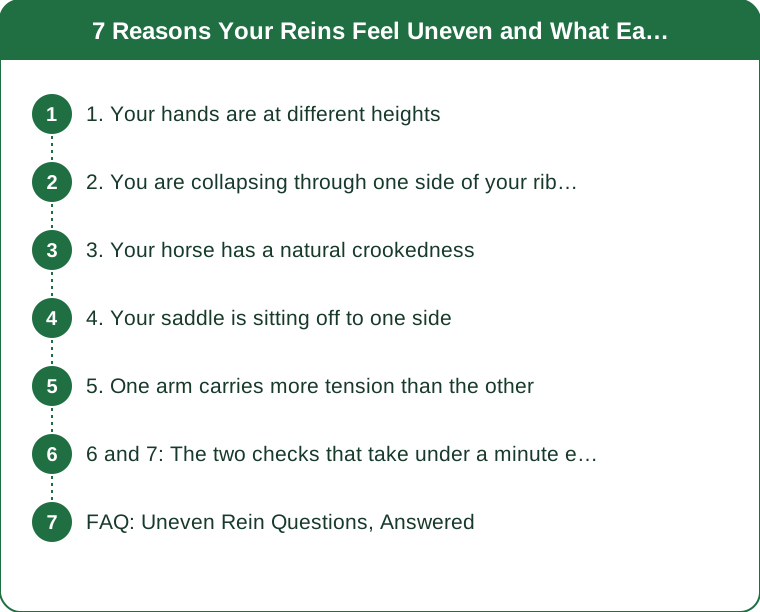
1. Your hands are at different heights
The most common cause and the least noticed. A hand carried even an inch higher on one side changes the angle of the rein through the bit ring entirely, which changes the feel of contact without anything else being different.
Riders almost never see this from the saddle. From above, both hands look correct because you are looking down a line. From the ground or on video, a height difference is obvious immediately.
The cause is usually a shoulder difference, not a hand one. A dropped shoulder brings the whole arm down, and correcting at the hand while the shoulder stays dropped creates a bent wrist that transmits tension into the rein.
Fix: video from the front for ten seconds. Then correct at the shoulder and let the hand follow. Riding with a whip laid across both thumbs is a classic exercise that makes any height difference immediately obvious to the rider.
2. You are collapsing through one side of your ribcage
A collapsed side shortens your torso on that side and shifts your weight onto the opposite seat bone. The horse feels a weight aid you never intended and drifts, and you then take up more rein on one side to correct the drift.
This is extremely common and often invisible to the rider because the position feels straight from the inside. A collapsed right side usually presents as a heavy left rein, since the horse is compensating for a weight shift.
Desk work and daily habits build it in. A side you habitually lean on at a desk or carry a bag over shows up in the saddle, and it is the same asymmetry, not a riding-specific fault.
Fix: check the distance from your armpit to your hip on each side while halted. Sitting tall on the collapsed side without leaning the other way is the correction. Off-horse side-plank and lateral core work addresses the root, which pure riding practice will not.
3. Your horse has a natural crookedness
Horses, like people, have a stiffer side and a more flexible one. Most horses are naturally hollow through one side and stiff through the other, which produces exactly the heavy-rein and light-rein pattern riders describe.
The stiff side gives you the heavy contact; the hollow side gives you nothing. On the hollow side the horse bends too easily and evades the contact; on the stiff side it braces against it. Both are the same underlying crookedness seen from two directions.
Shortening the light rein makes it worse. Taking more contact on the evading side encourages further evasion, while the stiff side stays braced.
Fix: ride the horse forward and straight rather than pulling. Work that engages the inside hind leg - leg yield, shoulder-in, transitions - addresses the actual cause, which is behind, not in the mouth. This takes months, not sessions, and it is genuinely the correct answer.

4. Your saddle is sitting off to one side
A saddle that slips consistently to one side puts you off-centre before you have done anything, and no amount of rider correction fixes a tack problem.
Slipping is not always the saddle’s fault. A rider who sits heavier on one side pushes the saddle that way, and asymmetric muscling on the horse’s back can do the same. It is often circular - a crooked rider slips the saddle, a slipped saddle keeps them crooked.
Check after riding, not before. Mount, ride ten minutes, then have someone check the saddle position from behind while you are halted. That tells you far more than a static check.
Fix: professional saddle fit assessment if it slips consistently. A fitter can distinguish between a tree that does not suit the horse’s shape and a rider-caused slip, which are different problems with different solutions. Shimming a pad is a temporary measure, not a fix.
5. One arm carries more tension than the other
Your dominant arm typically grips harder and stabilises more, and a gripping arm cannot follow the horse’s head movement. The rein on that side feels dead or heavy because it is not following.
The horse then avoids that side of the contact, taking more weight into the following rein - producing the classic pattern of one rein heavy, one empty, with the heavy one on the less tense side.
Tension usually lives in the elbow and shoulder, not the hand. An elbow locked against the ribs cannot follow at walk or canter, both of which require the arm to move with the horse’s neck.
Fix: notice whether your elbows swing. At walk, the elbows should open and close visibly with each stride as the horse’s head nods. If one does and one does not, you have found it. Riding at walk with deliberately soft elbows for five minutes at the start of every session builds the habit faster than any hand-focused exercise.
6 and 7: The two checks that take under a minute each
6. You are looking in one direction more than the other
Head position drives weight distribution far more than riders expect. The head weighs roughly 10 to 11 pounds, and carrying it slightly off-centre shifts your whole weight distribution in the saddle.
Riders habitually check the horse’s inside shoulder or look down at one hand. Persistent looking to one side tilts the shoulders and collapses a side, delivering an unintended aid. Looking down in general lightens your seat and heavies your hands - the two things you least want.
Fix: pick a point at the far end of the arena and hold it through a turn. Riding a whole session consciously looking where you are going, not at the horse, frequently changes the rein feel within one session.
7. The bit or bridle is not sitting evenly
Cheekpieces at different lengths put the bit at an angle in the mouth, and the two sides then genuinely feel different because they are. Count the holes on each cheekpiece - leather stretches unevenly and a bridle adjusted over months drifts. A single hole difference is enough to feel.
Dental issues create real one-sided resistance. Sharp points, an uneven bite, or a sore spot make a horse avoid contact on one side genuinely and consistently, and no riding correction will fix a dental problem.
Fix: check the bridle holes today, and book a dental if the change was sudden. A gradual asymmetry is usually rider or training; a sudden one is usually physical. That distinction is the most useful diagnostic in this whole list.
FAQ: Uneven Rein Questions, Answered
Should I just shorten the light rein?
No, as a primary fix. Shortening the rein the horse is evading encourages further evasion and does nothing about the cause. Even contact is a result of straightness, not a way to create it.
How long does it take to fix?
Rider position habits can change noticeably within a few sessions; horse crookedness typically takes several months of consistent straightening work because it involves muscular development, not just a movement pattern. Both usually improve together.
How do I know if it is me or the horse?
Have someone else ride your horse, and ride a different horse yourself. If the pattern follows you, it is you; if it stays with the horse, it is the horse. This single test answers in one session what months of guessing will not.
TL;DR:
- Uneven rein feel is usually created by the rider and reinforced by the horse - diagnose in that order.
- Hand height, a collapsed side, arm tension, and head position are the four rider causes worth checking first.
- Natural horse crookedness gives a heavy stiff side and a light hollow side - fix it with forward straightening work, not more rein.
- Check cheekpiece holes and saddle position after riding, not before.
- A gradual change is usually training; a sudden change is usually physical and deserves a dental or vet check.
Film ten seconds from the front at walk this week. Hand height differences are invisible from the saddle and obvious on video.
Keep Reading
This article is for general informational and styling purposes only. Fit, sizing, and product availability may vary.