7 Reasons Your Horse Responds Differently to You Than to Your Instructor
Quick Answer: Horses respond to clarity and timing, not authority. Your instructor’s aids are smaller, faster and more consistent than yours, their body stays quiet between cues, and crucially they release pressure the instant the horse responds. The gap almost always comes down to timing of the release, unconscious conflicting signals, and tension you cannot feel. All seven of the reasons below are trainable, and most improve within a few lessons once you know to look for them.
Your instructor gets on. The horse transitions cleanly, bends properly, stands still.
You get on. The same horse drifts, ignores you, and cuts the corner every single time.
It is not the horse’s opinion of you.

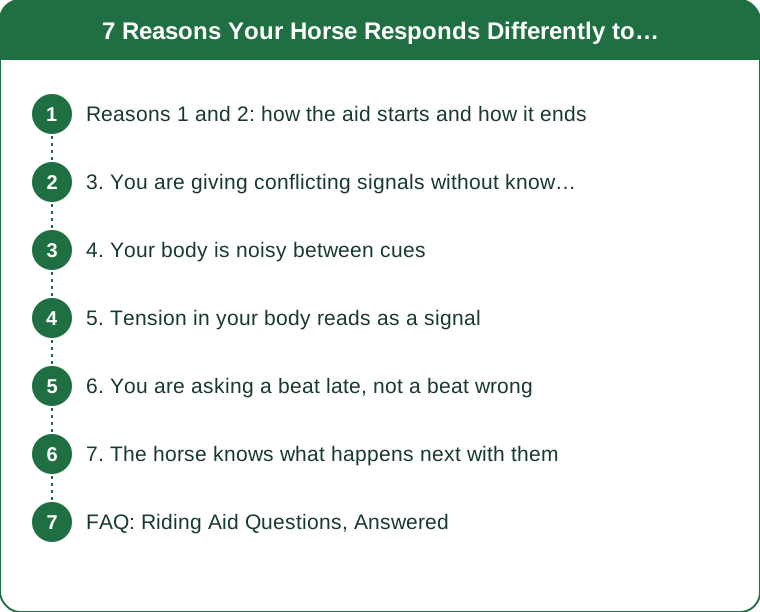
Reasons 1 and 2: how the aid starts and how it ends
1. Their release is faster than yours
This is the biggest one by a wide margin.
Horses learn from the removal of pressure, not its application. The moment the horse gives what you asked, the aid must stop — and ‘the moment’ means within a fraction of a second.
Most learners hold the aid a beat too long, either from uncertainty or from wanting to be sure. That extra beat teaches the horse that responding does not actually make the pressure go away, so the response gets duller.
Practical fix: ask, then deliberately release before you feel ready. If you have to choose between releasing slightly early and slightly late, always choose early.
2. Your aids are louder than they need to be
Experienced riders use aids so small they are hard to see from the ground. Learners use aids that are visible from across the arena.
Bigger is not clearer. A loud aid gives the horse a large, vague signal, and the horse has to guess which part of it mattered.
There is also a habituation problem: a horse ridden with heavy aids adapts to them, so you need progressively more. This is exactly how a sensitive horse becomes ‘dead to the leg’.
Practical fix: ask with the smallest aid you think could possibly work. If nothing happens, escalate — then next time start small again. Always return to the whisper.
3. You are giving conflicting signals without knowing it
The classic is asking for forward with the leg while unconsciously holding with the hand.
Others are extremely common: leaning into a turn while asking the horse to bend the other way, gripping with the knee while asking for more impulsion, tipping forward at the exact moment you want the horse to lift its shoulder.
From the horse’s point of view, two contradictory instructions arrived simultaneously, so it does the safest thing and does nothing, or something in between.
Practical fix: film a few minutes of your lesson. Conflicting aids are nearly impossible to feel and immediately obvious on video.
4. Your body is noisy between cues
Instructors are still when they are not asking for anything. Learners are constantly making small adjustments — shifting seat, fiddling with reins, bouncing a heel.
If your body is always talking, the horse cannot tell which movement was a signal. Quiet between aids is what makes the aids legible.
This is also why horses often go better for a calm rider who knows less technique than for an anxious one who knows more.
Practical fix: ride a full lap deliberately doing nothing at all. Most riders find this surprisingly difficult, which is the point.

5. Tension in your body reads as a signal
Horses are extraordinarily sensitive to muscle tension through the seat and legs. A braced thigh, a locked lower back or a gripped calf all transmit directly.
Nervousness produces exactly these, which is why anxiety about a horse behaving badly is a reliable way to make it behave badly.
Your instructor is not braver by temperament — they are relaxed because they have done it thousands of times, and the horse feels that relaxation as an absence of conflicting input.
Practical fix: breathe out audibly at transitions. It is a physical intervention, not a mindset one — exhalation releases exactly the muscles that brace.
6. You are asking a beat late, not a beat wrong
Timing within the horse’s stride decides whether an aid is even possible to obey.
Asking a hind leg to step further under only works while that leg is off the ground. Ask when it is planted and the horse physically cannot comply, regardless of how correct your aid was.
This is why the same leg aid produces a beautiful transition once and nothing the next three times. Not strength — phase.
Practical fix: learn to feel the outside hind at walk by having someone call it out from the ground. Once you can feel it, transition timing improves quickly.
7. The horse knows what happens next with them
Horses are excellent pattern learners and slightly cynical ones.
With an instructor, the horse expects consequences to follow instantly and consistently, so it responds to the first, smallest ask. With a learner it has often discovered that ignoring the first ask costs nothing.
This is not disrespect. It is efficient behaviour based on evidence, and the horse updates its evidence within a few rides.
Practical fix: be boringly consistent for three sessions. Same aid, same escalation, same instant release. Most horses recalibrate within a week, and the change can be startling.
This is general information, not veterinary or professional coaching advice. Any sudden change in a horse’s behaviour warrants checking for pain, tack fit or health issues first.
Seasonal note: as the weather cools, horses are typically fresher and more reactive, which exaggerates every one of these seven. A horse that felt willing in August can feel like a different animal in October — the aids have not changed, the baseline energy has.
FAQ: Riding Aid Questions, Answered
How long before a horse responds better to me?
With consistent timing and release, often three to five rides. Horses update quickly when the pattern is reliable.
Should I use a stronger aid if nothing happens?
Escalate within that request, then start small again next time. Never simply begin louder.
Why does the horse go well at the start of the lesson and worse at the end?
Usually rider fatigue producing noisier aids, plus horse fatigue. Ending on a good repetition matters more than ending on a hard one.
Is it really not about confidence?
Confidence matters, but through your body — relaxed muscles, quiet hands, steady breathing. That is what the horse actually reads.
Should I ride different horses or stick with one?
One horse builds consistency; different horses build adaptability. Most riders progress fastest with a familiar horse plus occasional variety.
How do I know if it is me or the horse?
If an experienced rider gets a clean response immediately, it is the aids. If they also struggle, check tack fit, soundness and health before anything else.
TL;DR:
- The release, not the aid, is what teaches. Release early rather than late.
- Use the smallest aid that could work, then escalate — and start small again next time.
- Conflicting aids and a noisy body between cues are invisible to you and obvious on video.
- Timing within the stride decides whether the horse can even obey.
- Horses respond to consistency within a few rides — this is trainable, not innate.
Film five minutes of your next lesson. The two or three things you will see are exactly the gap between you and your instructor.
Keep Reading
This article is for general informational and styling purposes only. Fit, sizing, and product availability may vary.