7 Reasons Posting Trot Stays Exhausting Far Longer Than It Should
Quick Answer: Posting should be powered mostly by the horse’s motion, with your legs directing rather than lifting. Riders who find it exhausting after months are almost always standing up out of the saddle with quad effort, gripping with the knee, or posting out of rhythm with the horse. Fitness helps at the margins, but the seven habits below are what actually decide whether posting costs you a little energy or a lot.
There is a point in most riders’ first year where they expect posting the trot to click. For some it does. For others, a year in, twenty minutes of trot work still leaves them breathing hard and their thighs burning, and the usual advice — get fitter — does not seem to be working.
It is not usually a fitness problem. Posting done correctly is close to energetically cheap. Done incorrectly, it is essentially a set of standing quarter squats performed on an unstable surface, which is exhausting for anybody.
Here are the seven things that most often separate the two.

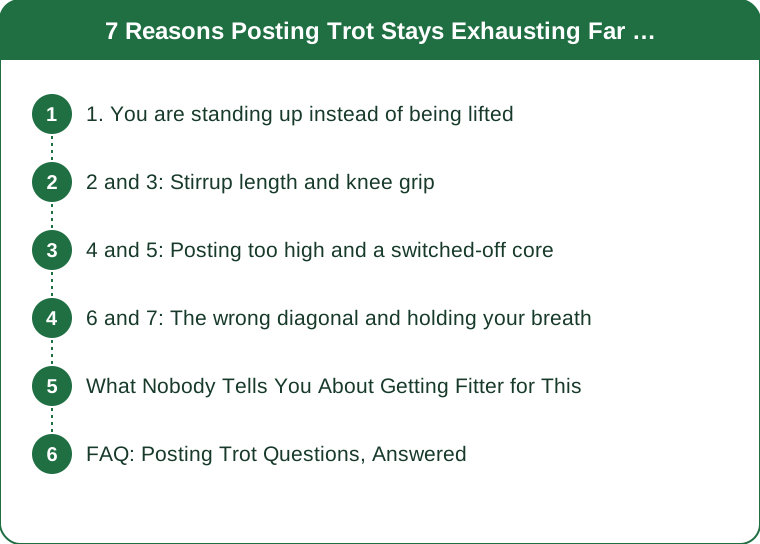
1. You are standing up instead of being lifted
This is the root cause behind most of the others.
The horse’s trot produces an upward impulse. Your job is to allow that impulse to move you out of the saddle and then control the descent — not to generate the rise yourself. Riders who actively push up with their quads are doing the work the horse was already doing for free.
The tell is timing: if you are rising slightly before the horse lifts you, you are generating it. If you are rising with the motion, you are allowing it.
Try this at the walk first: let the horse’s movement move your hips and do nothing to help. Then in trot, think of the rise as being tipped forward and up rather than pressed up. Many riders find the effort drops immediately and dramatically once they stop helping.
2 and 3: Stirrup length and knee grip
2. Your stirrups are too long
A stirrup even one hole too long forces you to reach with your toe to keep contact, which straightens the leg and takes away the angle you need to absorb and return motion.
Standard check: with your feet out of the stirrups and legs hanging, the bottom of the iron should hit at roughly your ankle bone. For flatwork posting, most riders are better one hole shorter than they think, particularly while learning.
Too long also destabilizes the lower leg, which sends riders looking for stability by gripping — which is the next problem.
3. You are gripping with the knee
Knee grip is the single most common energy leak in the posting trot, and it is almost always a response to feeling unstable.
Gripping with the knee turns your leg into a pivot point and swings your lower leg backward, which puts you in front of the motion. It also isolates the quad as the only muscle available to lift you, which is exactly the situation you are trying to avoid.
Your leg should be draped, with weight dropping through a soft knee into the heel. The stability comes from the weight in your heel and the balance of your torso, not from clamping.
A useful drill: post at the trot with your knees deliberately slightly away from the saddle for ten strides. It feels precarious. It also forces you to balance rather than grip, and most riders find the burn in their thighs stops.
4 and 5: Posting too high and a switched-off core
4. You are posting too high
A big, exaggerated rise takes more effort and puts you out of phase with a horse whose trot may not be that big.
The rise should be small — a few inches, driven by what the horse gives you. Watch experienced riders and the movement looks almost subtle. Beginners often post twice the necessary height because they were taught to rise and interpreted that as a large movement.
Match the height to the horse. A big-moving warmblood produces a bigger rise than a smooth quarter horse, and posting the same height on both means you are working hard on one of them for no reason.
5. Your core is switched off, so your back does the work
When the trunk is not engaged, the rise gets driven from the lower back, which is both inefficient and a reliable route to post-ride back soreness.
A gently braced midsection lets the impulse travel from the horse into your seat and up through a connected torso. A slack midsection absorbs it and forces the legs and lower back to compensate.
This does not mean rigid. A locked torso cannot follow the horse. Think of it as engaged and elastic — able to transmit motion without collapsing.
If your lower back is what hurts after riding rather than your legs, this is usually the item to work on.

6 and 7: The wrong diagonal and holding your breath
6. You are on the wrong diagonal and fighting the horse
Being on the wrong diagonal does not just look wrong to an instructor. It means you are sitting down when the horse’s mechanics are pushing you up.
You are working against the impulse on every stride, which is precisely the condition that makes posting feel like exercise. Riders who cannot yet feel the diagonal often describe the trot as bumpier and harder on one rein than the other, which is the clue.
Learn to feel it rather than look down: as the outside shoulder goes forward, you rise. Glancing down tips your torso and creates its own problems, so use it only to check while learning.
7. You are holding your breath
Almost universal in newer riders, and it converts a manageable effort into an exhausting one within a few minutes.
Concentration produces breath-holding, and breath-holding produces both fatigue and tension, which feeds back into gripping. Count your posts out loud for ten strides. You cannot count and hold your breath at the same time, and most riders report the trot feeling noticeably easier within a lap.
It sounds too simple to matter. It is consistently one of the fastest improvements available in a lesson.
What Nobody Tells You About Getting Fitter for This
Off-horse conditioning does help, but the useful kind is not what people assume.
Endurance riding fitness is mostly postural endurance and single-leg stability, not quad strength. Riders who add heavy squats often find posting no easier, while riders who add split squats, single-leg balance work, and plank-family core work usually do.
The other underrated element is ankle mobility. Weight dropping into a heel requires dorsiflexion; a stiff ankle cannot absorb, so the knee and hip take over and the leg stiffens. Two minutes of calf and ankle mobility before riding is a small investment with a visible return.
But sequence matters: fix the mechanics first. Getting fitter at doing it wrong produces a rider who can tolerate an inefficient posting trot for longer, which is not the goal.
FAQ: Posting Trot Questions, Answered
How long should it take before posting stops being tiring?
With good mechanics, most riders find it manageable within two to three months of regular lessons. If you are past six months and still exhausted after ten minutes, treat it as a technique issue rather than a fitness one and ask your instructor to watch specifically for knee grip and rise height.
Should I practice posting without stirrups?
Rising trot without stirrups is a strength exercise, not a technique exercise, and it can reinforce gripping if done too early. Sitting trot without stirrups is generally more useful at that stage. Follow your instructor’s judgment on timing.
Is it normal for one direction to feel much harder?
Yes, and it usually reflects a combination of the diagonal you habitually favor and the horse’s own asymmetry. Deliberately practice the harder rein more — most riders unconsciously do the opposite.
TL;DR:
- Posting should be powered by the horse’s impulse, not by standing up out of the saddle with your quads.
- Check stirrup length first — one hole too long causes most of the downstream problems.
- Knee grip, an exaggerated rise, a slack core, the wrong diagonal, and held breath are the other five big energy leaks.
- Off-horse work helps most when it is single-leg stability, core endurance, and ankle mobility — not heavy squats.
If posting still wrecks you after months, do not train harder. Have someone watch for knee grip and rise height, and fix the mechanics — the fitness requirement turns out to be much lower than you thought.
Keep Reading
This article is for general informational and styling purposes only. Fit, sizing, and product availability may vary.