7 Mistakes That Make Riding Lessons Feel Harder Than They Should
Quick Answer: Most of what makes early riding lessons feel exhausting isn’t the horse or the skill itself — it’s fixable habits like gripping with hands instead of legs, wearing the wrong footwear, and tensing the whole body instead of just where it’s needed, all of which drain energy far faster than correct technique does.
Here are the seven most common ones, and what to do differently in the saddle.

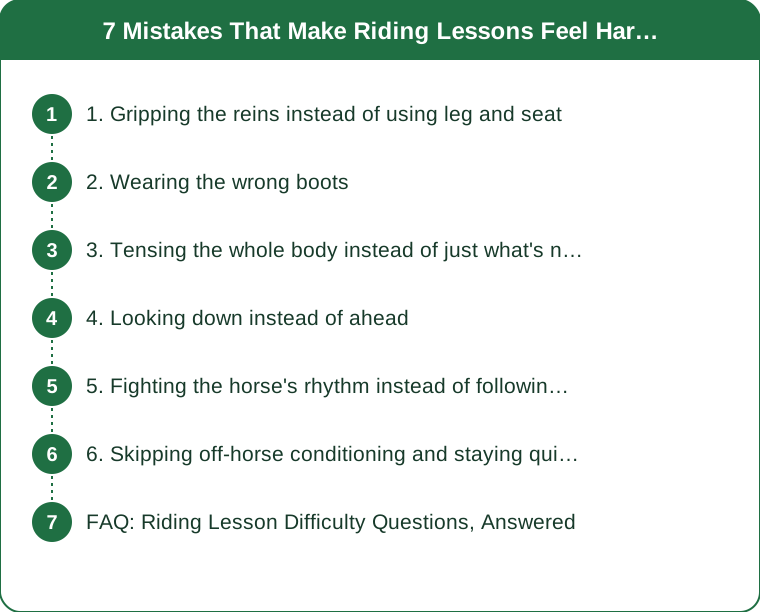
1. Gripping the reins instead of using leg and seat
New riders instinctively hold on with their hands and arms when nervous. This tires the arms fast and confuses the horse, since reins are for communication, not balance — balance comes from the seat and legs, which is the harder but more sustainable skill to build early.
2. Wearing the wrong boots
Sneakers or boots with the wrong sole can let a foot slide too far into the stirrup, a real safety issue, or slip out constantly, wasting energy on re-positioning. Proper riding boots with a slight heel and smooth sole solve both problems at once.
3. Tensing the whole body instead of just what’s needed
Nervous beginners often stiffen everywhere — shoulders, jaw, core, legs all at once. This full-body tension burns through energy far faster than a targeted, relaxed-but-engaged posture, and it also makes the horse tenser, since horses pick up on rider tension.

4. Looking down instead of ahead
Watching your hands or the horse’s neck feels natural but throws off balance and posture. Looking up and ahead, toward where you’re actually going, keeps the spine aligned and makes balance noticeably easier to maintain.
5. Fighting the horse’s rhythm instead of following it
Beginners often brace against the horse’s motion instead of moving with it, especially at the trot. This creates a bouncing, exhausting fight against the horse’s natural rhythm rather than syncing with it, which is both more tiring and less effective.
6. Skipping off-horse conditioning and staying quiet about discomfort
Riding uses core, inner thigh, and postural muscles that most people don’t train elsewhere. A little off-horse conditioning — planks, hip mobility work — makes lessons feel dramatically less exhausting within just a few weeks. On top of that, many beginners push through pain or fear silently rather than flagging it — a good instructor can adjust the horse, the exercise, or the pace, but only if they know something feels off, and staying quiet just makes the lesson harder than it needs to be.
FAQ: Riding Lesson Difficulty Questions, Answered
How long does it typically take for lessons to stop feeling this exhausting?
Most new riders notice a real difference within 6-8 consistent lessons, as the specific muscles and balance reflexes involved start to develop.
Is soreness after lessons normal, or a sign something’s wrong technique-wise?
Some soreness is completely normal for the first several weeks, especially in the inner thighs and core; sharp pain or joint discomfort is worth mentioning to the instructor.
Does a different horse change how tiring a lesson feels?
Yes, somewhat — a horse with smoother gaits is generally easier for beginners than one with a rougher, more jarring stride, and instructors often account for this when pairing beginners.
TL;DR:
- Gripping with hands and arms instead of legs and seat drains energy fast and confuses the horse
- The wrong footwear and full-body tension both waste effort that could go toward actual balance
- Looking ahead instead of down, and moving with the horse’s rhythm instead of against it, both reduce fatigue
- Off-horse conditioning and honest communication with the instructor round out the fix
None of these fixes require more strength or bravery — they’re technique adjustments, and most riders feel a noticeable difference within a few corrected lessons.
Keep Reading
This article is for general informational and styling purposes only. Fit, sizing, and product availability may vary.