7 Horseback Riding Habits That Quietly Strain Your Lower Back Without Feeling Like Bad Form
Quick Answer: Several common riding habits — gripping with the lower back instead of the core and legs, arching or rounding the spine to compensate for balance uncertainty, holding tension through the shoulders that travels down the spine, and riding predominantly on one diagonal without alternating — can each individually seem minor but combine to place repeated strain on the lower back over a riding session and across multiple lessons.
None of these habits look dramatically wrong from the ground, which is exactly why they tend to go uncorrected long enough to cause real strain.

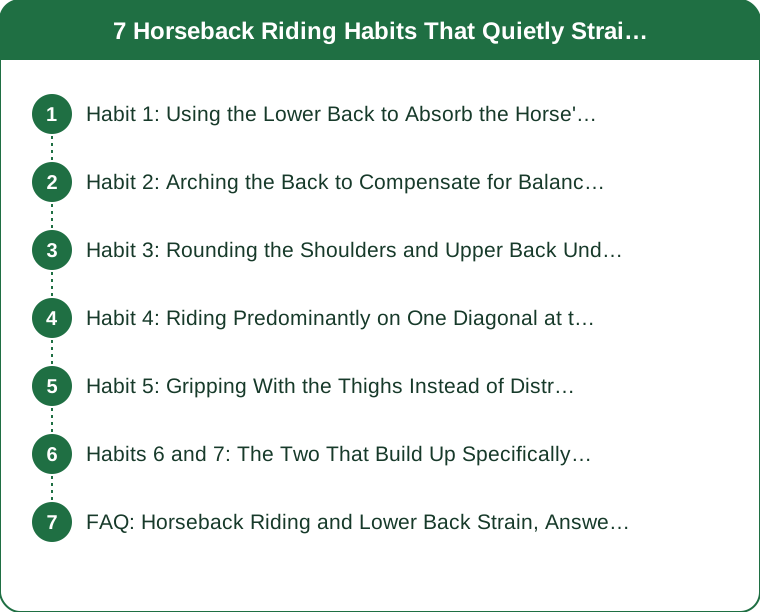
Habit 1: Using the Lower Back to Absorb the Horse’s Motion Instead of the Core
Relying on the lower back to absorb a horse’s movement, rather than engaging the deeper core muscles that are meant to stabilize the rider, places repetitive strain directly on the lumbar spine over the course of a ride.
Habit 2: Arching the Back to Compensate for Balance Uncertainty
New riders who feel unstable often unconsciously arch the lower back in an attempt to feel more secure, which actually increases spinal compression rather than providing the stability the rider is seeking.
Habit 3: Rounding the Shoulders and Upper Back Under Tension
Tension held in the shoulders and upper back during a ride commonly travels down through the spine, adding compounding strain to the lower back even though the initial tension started elsewhere.

Habit 4: Riding Predominantly on One Diagonal at the Trot
Consistently favoring one diagonal at the trot, rather than alternating as instructed, can build asymmetric strain patterns in the lower back over time, even when each individual ride feels fine.
Habit 5: Gripping With the Thighs Instead of Distributing Weight Through the Seat
Over-gripping with the thighs to feel secure shifts weight distribution away from the seat bones, which can force the lower back to compensate for balance that the seat and legs should be providing.
Habits 6 and 7: The Two That Build Up Specifically Over Multiple Lessons
Habit 6: Not Adjusting Position Between Different Gaits
Maintaining the same rigid position across walk, trot, and canter, rather than adjusting posture for each gait’s specific demands, forces the back to compensate in ways each gait wasn’t designed to require.
Habit 7: Skipping Core-Strengthening Work Between Lessons
Relying solely on riding time itself to build the core strength that supports good position means that strength develops slowly, leaving the lower back to compensate in the meantime.
FAQ: Horseback Riding and Lower Back Strain, Answered
Is some lower back soreness after early riding lessons considered normal?
Mild soreness from using less-familiar stabilizing muscles is common for new riders, but sharp or persistent pain is worth mentioning to an instructor rather than continuing to ride through it.
Can an instructor actually help identify these habits from the ground?
Yes — many of these postural habits are visible from the ground, and pointing them out is a standard, expected part of lesson-based correction for newer riders.
Does off-horse core strengthening actually help reduce this strain?
Yes — building core strength specifically supports the stabilizing role the core is meant to play while riding, reducing how much the lower back needs to compensate.
TL;DR:
- Using the lower back instead of the core to absorb motion is the most common source of strain
- Arching to compensate for balance uncertainty increases spinal compression, not stability
- Tension in the shoulders and inconsistent diagonal use both add to compounding strain over time
- Off-horse core strengthening between lessons reduces how much the lower back has to compensate
Keep Reading
This article is for general informational and styling purposes only. Fit, sizing, and product availability may vary.